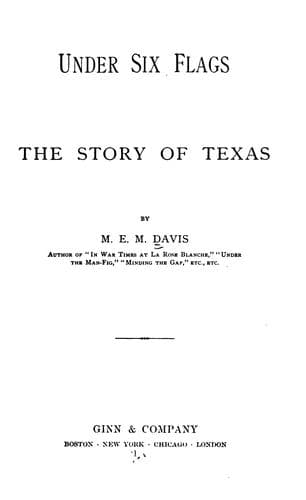
Under Six Flags: The Story of TexasDavis, M. E. M. (Mollie Evelyn Moore)
History
Under Six Flags: The Story of Texas
Davis, M. E. M. (Mollie Evelyn Moore)
Texas -- History
Several of the prisoners made their escape. Among these was Colonel
Thomas Jefferson Green, who had been Fisher’s second in command. He was
bitterly opposed to the surrender at Mier, and broke his sword across
his knee rather than hand it to General Ampudia. Mr. John Twohig, of San
Antonio, who had been carried into captivity by Woll, and several of his
fellow-prisoners made a tunnel under the prison wall, through which they
succeeded in getting out of the Castle and thence safe home again.
[Illustration: Anson Jones.]
Mr. Wright of De Witt County was not so lucky. He was a very large man;
after making his preparations for flight, he crawled into the tunnel,
where he got along famously until he was about half way through. There
he stuck fast, equally unable to go forward or to come back. Finally,
with a despairing effort he slid back an inch or two, then a little
further, until at last bruised, breathless, and torn, he got back into
his dungeon, glad to settle down to prison life once more.
Among the captives was Samuel H. Walker, afterwards famous as a captain
of cavalry in the Mexican war with the United States.
In September, 1844, these prisoners were finally released by Santa Anna,
at the dying request, it is said, of his young and beautiful wife.
About the time the Mier expedition started from San Antonio, the capital
was again removed from President Houston’s beloved town on Buffalo
Bayou; this time to Washington on the Brazos.
VII.
AUSTIN.
(1842-1861.)
1. “THE REPUBLIC IS NO MORE.”
From 1842 to 1844 the Texan Congress held its meetings at Washington on
the Brazos—the spot where, a few short years before, the declaration of
independence had been adopted.
The nation born amid the gloom and uncertainty of that stormy time now
stood forth proud in the consciousness of growing strength, free and
full of hope for the coming years.
An armistice was signed with Mexico (1843) which left the Republic at
peace. The Indians under the wise rule of the “Big White Chief,”
Houston, made but few outbreaks. Year by year more fields were fenced
in, more orchards and gardens were planted, more dooryards were set with
vine and rose-tree.
Immigrants poured in. Many came from “the States”; but others crossed
the wide seas to find homes in that fertile Texas whose story of
struggle and triumph was in everybody’s mouth. Henry Castro, a French
gentleman, who was consul-general for Texas at Paris, obtained in 1842
large grants of land from the Republic, and brought over five hundred
families from France. These settled on the Medina River west of San
Antonio. Another important colony came from Germany under the leadership
of the Prince de Solms, and founded the thrifty town of New Braunfels on
the Guadalupe.
Public-domain text, read in full here on John Shaqi.
Reviews
Reviews
No reviews yet
Be the first to share your thoughts on this work.
Elsewhere in the archive
Join the Discussion
Join the discussion
Sign in to leave a comment or review.
Sign InorCreate an account