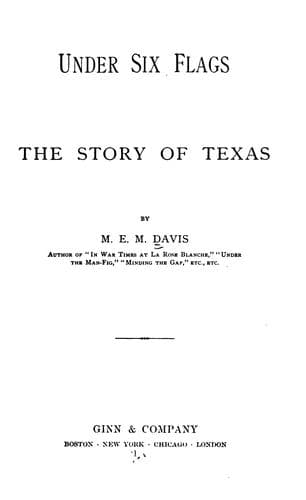
Under Six Flags: The Story of TexasDavis, M. E. M. (Mollie Evelyn Moore)
History
Under Six Flags: The Story of Texas
Davis, M. E. M. (Mollie Evelyn Moore)
Texas -- History
Sam Houston succeeded Runnels as governor in 1859. When he took his seat
at Austin, clouds from more than one quarter were gathering in the clear
sky of Texas. Roving bands of Indians from the Territory came across the
border and murdered in cold blood a number of families. At first they
stole in, made their raids, and dashed back in a single night. But they
grew more and more bold and insolent, until the governor was obliged to
send the rangers to their old work of watching the frontier.
Lawrence Sullivan Ross, afterward governor of Texas, was at this time a
lieutenant in the ranging service. He was a gallant and dashing soldier.
During a raid on the Indians, on Pease River (1860), he rescued Cynthia
Ann Parker, a white woman, who had been carried away by the Comanches,
when but nine years of age. She had been a captive twenty-four years and
had forgotten her native tongue. She was the wife of Peta Nocona, a
Comanche chief, and the mother of several children. Lieutenant Ross
returned her to her kindred with her little daughter Ta-ish-put (Prairie
Flower). But she was not happy among these long-unknown white people;
she pined for her dusky adopted kinsmen; and four years after her rescue
she died, little Ta-ish-put soon following her to the Happy
Hunting-grounds. Inanah Parker, one of her sons, became a Comanche
chief.
During this period a Mexican bandit named Cortina crossed the lower Rio
Grande into Texas at the head of four hundred men. Their object was
plunder, and in their forays a great many innocent people were killed.
The governor appealed to the general government at Washington for
protection along the Mexican border.
The War Department in response ordered Colonel Robert E. Lee (afterward
famous as commander-in-chief of the Confederate States army), then
stationed at San Antonio, to attack the bandit and drive him out,
crossing the Rio Grande, if necessary, in pursuit.
Some United States troops, with several companies of rangers, were at
once put in the field, and Cortina’s band was soon broken up.
These troubles were light, however, compared with those which were about
to follow.
The two sections of the United States, the North and the South, had for
some years been drifting apart. Their views differed widely on several
important questions, particularly the question of states’ rights, and
there seemed to be no chance of a mutual agreement. In 1860, at the time
Abraham Lincoln was elected President, the Southern States determined to
withdraw from the Union. They believed that each state had a right to
withdraw or secede from the Union whenever that Union became for any
reason undesirable to it, as the individual members of a family may
leave the paternal home if they wish to do so. But the Northern States
did not agree to this. They believed that the Union should be preserved,
and that the states should be held together—even by the power of the
sword.
Public-domain text, read in full here on John Shaqi.
Reviews
Reviews
No reviews yet
Be the first to share your thoughts on this work.
Elsewhere in the archive
Join the Discussion
Join the discussion
Sign in to leave a comment or review.
Sign InorCreate an account