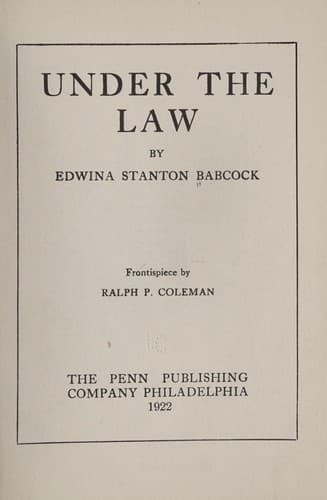
Amnesiacs -- Fiction; New York (State) -- Social life and customs -- Fiction; Trials -- Fiction; Young women -- Fiction
The dance at the Willow Roads Country Club took place the night before
Terry O'Brien's trial. Watts, with some feeling of wanting the life
pulses of the Minga Bunch about him, went leisurely down the mountain
road clad in the golf tweeds against which a club dance would not
discriminate. As he looked in through the long windows that opened on
the river, the lawyer was thinking that the indiscretions and bold
franchises of the youth of the day were somehow, though coarser, a
less harmful thing than the evasions and concealments of earlier days.
One thing the man, staring in upon the throngs watching the little
cubs of the "stag line" with their important faces, noting the calm,
inexpressive faces of the girls, would have asked for--enthusiasm.
Watts reviewed the whole history of the dance, Bacchante and stately
minuet and folk dance, gigue and morrice, and wondered what good the
dance was without the laughing lips, the light of the eyes, the merry
face. He saw the young figures of the girls coming down the staircase,
faces washed of all human expression, calm, subtle, in some instances
of a Cleopatra-like Eastern subtlety, but never gay. The tall, dark
man, accustomed to reading faces, wondered if indeed gayety had gone
out of the world. "Gayety," thought Watts, "means innocence. Perhaps
in a machine-run world there can be no innocence."
Down the staircase they came, scarlet and white satin, blue tulle,
black tulle, pretty gold and silver slippers. Little necks filmy with
powder, smooth heads, coiled, puffed and banded, long white arms,
smooth white sides visible to the waist. Feet and legs devoid of grace,
thickened by athletics and crudely pushed and planted in the unlovely
strutting dances, yet not so unnatural, not so different, just young
things pushed about by the great Energy--Life.
Any ballroom, the lawyer knew, spells but one thing. In spite of its
protected, assured air, its look of flowered convention and jeweled
dames playing propriety, it is, in all truth, the scene of the play of
young blood, the attraction of young creatures. Since the days of the
excitement over Byron's "Waltz" the eternal comment of men and women,
wall-flowers and chaperons evades this evident truth and registers the
same objection to all that is not sentimental convention.
But ballrooms go on existing. Watts, with a smile, wondered how many
dances were in full blast along the Hudson River, so many fields of
flower-pollen flying that Friday night. His mind wandered back over the
fair old stately days of the great mansions of the early Americans.
He thought about Colonial dances up and down this river, visualized
homes along the great stream, the time of Cooper's "Satanstoe," of
Irving's homesteads, of belles of the Revolution and the days of
Lincoln. Shipman, with his own peculiar imagination, reviewed the youth
and beauty of those days when, we are told, youth was so pure and
innocent, beauty so lovely and soft and mild and biddable.
Public-domain text, read in full here on John Shaqi.
Reviews
Reviews
No reviews yet
Be the first to share your thoughts on this work.
Elsewhere in the archive
Join the Discussion
Join the discussion
Sign in to leave a comment or review.
Sign InorCreate an account