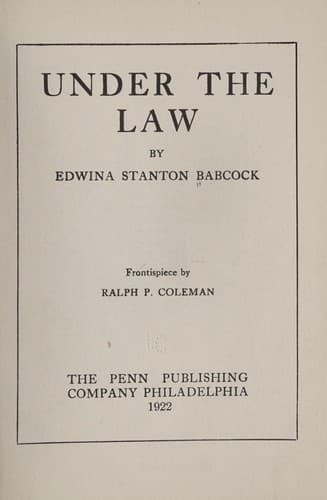
Amnesiacs -- Fiction; New York (State) -- Social life and customs -- Fiction; Trials -- Fiction; Young women -- Fiction
There was no answer. The older girl gently turned the knob and looked
in. The room was in moonlit whiteness. There, still in her rumpled blue
and orange, the little butterfly back bare, the arms tossed frantically
out, she lay, the whole figure prey to sweeping and tearing things.
Minga was curled up on the bed. There was no doubt about the little
shivers and shakes, she was sobbing.
"Minga--precious!" Something big and devastating tore through the
older girl's senses. She felt suddenly old, like Minga's mother. This
motherliness, though Sard did not know it, was a keystone to her being;
it was the thing Shipman had half seen, it was the beautiful balance
of the Winged Victory. The girl sat quietly down on the bed; so this
was another Law for her then; she must know keenly and helplessly the
sorrow of others, she must blindly strive to learn how to help. Dora,
Colter, and now little gay Minga.
"Minga," urged the girl, pitifully, "don't cry like that--why, it's not
that silly Bunch, is it? We don't care for them, we have other friends.
Watts Shipman and--and---" Sard went a little vaguely over a possible
list of "other friends." There was no answer, and she leaned down,
trying to raise the buried face. "Honey, can't I know?" then urgently,
"Minga, don't cry like that, it's--it's self-pity, isn't it?" Sard
groped about to give expression to a thought that was hardly formed
in her. "I suppose self-pity's one thing we must never, never let
ourselves have," the girl said softly.
There was a sudden cessation of sobs, and Minga slowly raising on her
elbows turned up in the half light a broken face.
"I can't help ... pitying myself.... I've been so--so crazy; and now,"
shuddering, "I can't play any more."
"You poor little thing, poor little thing," Sard paused, her
hand passed over the tousled head. This young face and hand were
inexperienced, but Sard was like a pilot trying to pierce mists. "I
guess we've always got to play," she said, "even when we--well, that
Punchinello idea, you know. But anyway, Minga, you mustn't cry like
that because it's wrong; it does something to your nerves. I remember
they said it in the psychology class."
"But I've done an awful thing," wept Minga. She sat up suddenly. "Sard,
you don't know what I did to-night," Minga lifted her hand and passed
it swiftly over her face as if she would brush away some new look of
shame and repeated:
"I've done the awful thing; I wouldn't have cared if it had been anyone
else, but I felt wild after I had given Tawny back his ring and I
thought I'd take a chance and so, oh, Sard, while we were dancing I
told Watts Shipman I loved him, and told him in a silly way, a Cinny,
Gertrude way, and that's the awful thing; for you see, Sard, I do love
him. Oh, I do, I do," cried poor little Minga. "But I told him in that
way, and he doesn't respect me."
Sard, rocked by a surprise that bordered very nearly on hysterical
laughter, crept up closer to the little sufferer.
Public-domain text, read in full here on John Shaqi.
Reviews
Reviews
No reviews yet
Be the first to share your thoughts on this work.
Elsewhere in the archive
Join the Discussion
Join the discussion
Sign in to leave a comment or review.
Sign InorCreate an account