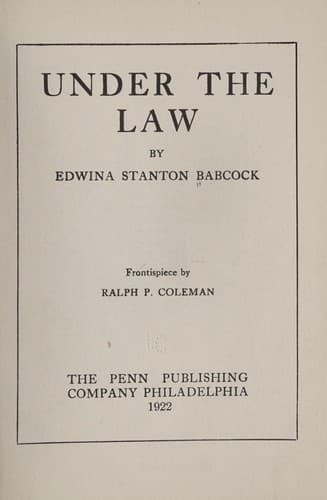
Amnesiacs -- Fiction; New York (State) -- Social life and customs -- Fiction; Trials -- Fiction; Young women -- Fiction
Eleanor nodded. "I've always believed it." Her eyes wandered to the
bloomy-purple of the line of mountains back of them. "Of course, I
never could understand why, if he was anywhere in the world, why, when
that happened he didn't come to us, to George and me. And after George
went, I wondered more but I've always felt him alive, in the world,
somewhere."
Watts was thoughtful. "He might have been afraid; he might have thought
it would hurt him some way, do you think that?"
"No," the woman lifted her head decidedly. "That's not a Ledyard trait.
Martin was as devoted to George as I--almost----" She shivered a little
on the word and the lawyer sadly watching her realized that that word
"almost" regulated the great gulf between the deep faith of a man's
loving, and the shattering blasts of a woman's power of sorrow. Eleanor
was silent a moment; then she said dreamily, "They adored each other at
college, camping, on expeditions, everywhere. Martin might have been
crushed by George's trouble, saddened beyond words, but he wouldn't
have deserted; he would have come to us if he could have!"
"But," the lawyer turned to the letter in his hand, "this chap says
that nearly all of the men in that West African expedition died of
smallpox. I remember that year; it was fearful along the Niger; there
was a lot of red tape and the Entente governments fought over whose job
it was to stamp the thing out. It swept the Congo, I know. They all
died, this chap Morrow says."
Eleanor Ledyard assented. "Nearly all, but they never accounted for
all. Tarrant, the man Martin loved so, went first; and after that
McCall, their surgeon; very bravely, I believe. Then the Southerner
who partly financed the thing, did you read that awful part where they
had to send them down the Niger in the canoes made of hollowed out
trees? Well, they and the natives say that six canoes came down and
that they burned all the smallpox victims in quick-lime. But, you see,
there was one letter from Martin himself, very distressed, out of West
Africa, at Monrovia, I think, as he waited to embark for England, and
he says--this letter, dated long after, sounds pretty nearly out of his
head--'they are all gone but me, and I was taken from the same canoe as
Tarrant. I was trying to paddle him down to a village for burial; he
had been dead four days when we got there, a putrid corpse! Tarrant, my
friend, my beloved brother-in-science.'"
For a long time there was silence. The man and woman sat staring at the
blue Ramapo as the strange scenes of the stricken men in the tropical
river drifted through their minds. At last Eleanor spoke: "And then
came 'George's Trial.'" Watts saw the terrible effort it was to her to
say the words, how she glanced at Pudge at her feet, and then, "George
went and Martin never came to me. Nobody came to me."
Watts sat there, the letter in his hand. "I came to you," he said
simply. She flashed him a look of passionate gratitude.
Public-domain text, read in full here on John Shaqi.
Reviews
Reviews
No reviews yet
Be the first to share your thoughts on this work.
Elsewhere in the archive
Join the Discussion
Join the discussion
Sign in to leave a comment or review.
Sign InorCreate an account