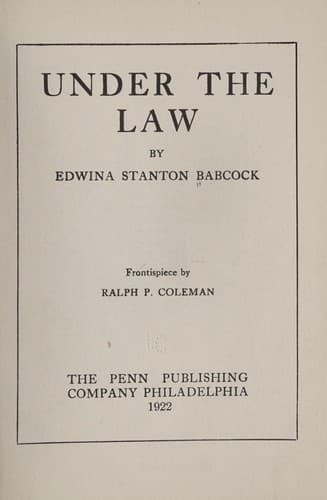
Amnesiacs -- Fiction; New York (State) -- Social life and customs -- Fiction; Trials -- Fiction; Young women -- Fiction
Watts, however, steadily met her glance. "Sard Bogart," he said, "is,
well, she's----" he broke off, looking earnestly at his friend. "That
girl is going to need friends," said the lawyer decidedly. He handed
the locket back to Eleanor, and with a curious look, half awe, half
ache, saw it slip into its place. He stopped, something trivial on his
lips. He was glad at Eleanor's next remark.
"I wish I might help her." Her voice was calm, sympathetic.
The lawyer was a little dubious, a little uncertain. "I don't know;
I've told her about you," he hesitated. Eleanor half shrank and
Watts added coolly, "That you are my dearest friend." He stood up
thoughtfully. "Unless you are going to ask me to lunch, I must go. Are
you going to ask me to lunch?" he asked her.
The old drama began instantly between them. The masterful, pursuing man
and the retreating, doubting woman. The thing itself took hold of them,
but resolutely, like people tempered to the grave concerns of life,
they put it aside.
Eleanor shook her head. "I am not going to ask you," she said gently.
"Punishment, I suppose," murmured Watts.
There was a moment's silence. She also rose and he thought that in her
white gown with the rows of blue larkspur and the canterbury bells as
background she was a wondrous fair thing that had almost too much power
over him. The man's mind flew to the bright impulse of the girl they
spoke of. Eleanor saw this and her hand went out to his. "Bring Sard to
see me," she said it very kindly, "and that funny little Cousin Minga.
I used to see a good deal of the 'Mede and the Persian'; they are
dears." She looked at him, casting about for something that should give
him comfort. "Next week you take up the O'Brien case, don't you? Tell
me, has the boy any chance? Can you save him? Is it to be for life?"
Watts turned; he looked long and silently at the sun descending, at
all the colors and life of the flowers about them, at the mountains
standing like great blocks of sapphire beyond the green fields awash
with daisies. Suddenly, he pointed to a little cedar tree reaching its
infant head close by their side.
"How long do you think that little thing has been there?"
Mrs. Ledyard thought about two years. "It's so cunning; it's planted
itself. I haven't had the heart to have it taken out."
"When it is a big tree," said Shipman slowly, "and when his bones are
brittle and when only images of sin and failure and disease are graven
on his soul, Terence O'Brien will be called 'free.'"
"Free," she murmured; her eyes, fixed on her friend's, read anew that
greatest and deepest thing in him, the passion for humanity.
Public-domain text, read in full here on John Shaqi.
Reviews
Reviews
No reviews yet
Be the first to share your thoughts on this work.
Elsewhere in the archive
Join the Discussion
Join the discussion
Sign in to leave a comment or review.
Sign InorCreate an account