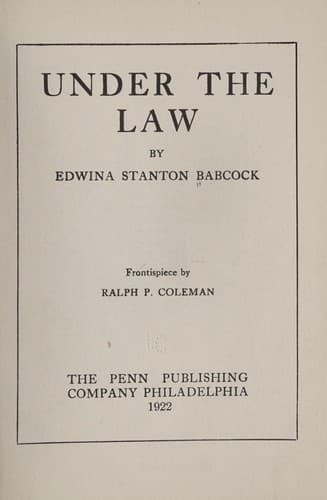
Amnesiacs -- Fiction; New York (State) -- Social life and customs -- Fiction; Trials -- Fiction; Young women -- Fiction
Minga stood pulling down her belt. She gave the bobbed head a resolute
shake. "I'm going," she said. She stood there, a curious little picture
of untried resolution. "I don't know exactly what's come over me," the
girl confessed. "I've nothing against you, Dunce; you've been a real
sweet idiot, and I'm going to see us through the Terry rescue, but
after the Terry rescue," said Minga in a solemn tone, "home I've got
to go." She hesitated a moment adding, "Anyway, after that, you see,
Judgie will hate me and turn me out and Aunt Reely will be nervous and
Sard will be queer and gloomy and you----"
"Anyway I'll be annoying," said Dunstan obstinately, "the way I've been
right along."
There was a long silence for this talkative pair. At last:
"Anyway," said Minga, "I sort of see things different. I can't seem
to want to visit around as much as I used. I'm going home to be a
daughter, that sort of thing."
"Oh, deliver us!" groaned Dunstan. "Oh my soul! Say, what's the matter,
girl, didn't your last allowance come? Nobody's a daughter nowadays; it
isn't done. Say, Minga, this is awful! Anyway--don't go!"
Minga stood first on one foot, then on the other. In her mind, a
little dazed and haunted by recent events, still rang Shipman's summing
up of her after their various encounters, and the final night at the
dance. The lawyer had held the two tantalizing hands very tightly and
murmured, "You are a very dear little thing, a very dear little thing."
He had said it with a sort of tortured groan. Minga was beginning
to realize with a good deal of slow pain how a man might resolutely
hold a girl like her away from himself and herself, from something to
which, the girl was clever enough to know, she had half unconsciously
tried to lure him. The sentence with its tender repudiation of her had
penetrated to something honest in her heart. Then had come the morning
outside the court-house when Shipman had defined life to them. The
older man's power, his penetrating analysis, had somehow reached to
the soul that lay dormant, the little butterfly character had sleepily
stirred, the little blue egg had broken, and Minga, a scared soul,
looked forth upon a universe that had a spiritual endlessness. Some new
dim sense of men came to her, not as strong creatures that must be made
silly slaves to women or played upon by light motives, but as loyal
brothers who had enormous power of strength or suffering through women.
Watts Shipman's world of standards and honor stood out to her like a
strange austere country of mountains and looming towers as to which she
was supremely curious, but into which her feet hardly knew how to tread.
Public-domain text, read in full here on John Shaqi.
Reviews
Reviews
No reviews yet
Be the first to share your thoughts on this work.
Elsewhere in the archive
Join the Discussion
Join the discussion
Sign in to leave a comment or review.
Sign InorCreate an account