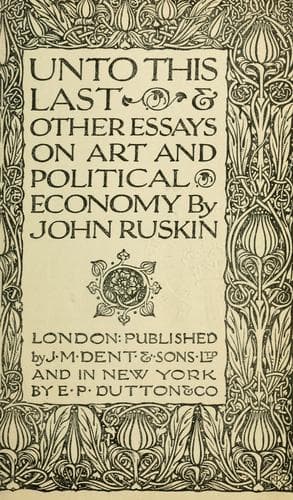
Unto This Last, and Other Essays on Political EconomyRuskin, John
General
Unto This Last, and Other Essays on Political Economy
Ruskin, John
Art; Economics
By the just procedure, the whole price of the first piece of work goes
into the hands of the man who does it. No surplus being left in the
employer's hands, _he_ cannot hire another man for another piece of
labour. But by precisely so much as his power is diminished, the hired
workman's power is increased; that is to say, by the additional half
of the price he has received; which additional half _he_ has the power
of using to employ another man in _his_ service. I will suppose, for
the moment, the least favourable, though quite probable, case--that,
though justly treated himself, he yet will act unjustly to his
subordinate; and hire at half-price, if he can. The final result will
then be, that one man works for the employer, at just price; one for
the workman, at half-price; and two, as in the first case, are still
out of employ. These two, as I said before, are out of employ in
_both_ cases. The difference between the just and unjust procedure
does not lie in the number of men hired, but in the price paid to
them, and the _persons by whom_ it is paid. The essential difference,
that which I want the reader to see clearly, is, that in the unjust
case, two men work for one, the first hirer. In the just case, one man
works for the first hirer, one for the person hired, and so on, down
or up through the various grades of service; the influence being
carried forward by justice, and arrested by injustice. The universal
and constant action of justice in this matter is therefore to diminish
the power of wealth, in the hands of one individual, over masses of
men, and to distribute it through a chain of men. The actual power
exerted by the wealth is the same in both cases; but by injustice it
is put all into one man's hands, so that he directs at once and with
equal force the labour of a circle of men about him; by the just
procedure, he is permitted to touch the nearest only, through whom,
with diminished force, modified by new minds, the energy of the wealth
passes on to others, and so till it exhausts itself.
The immediate operation of justice in this respect is, therefore, to
diminish the power of wealth, first in acquisition of luxury, and,
secondly, in exercise of moral influence. The employer cannot
concentrate so multitudinous labour on his own interests, nor can he
subdue so multitudinous mind to his own will. But the secondary
operation of justice is not less important. The insufficient payment
of the group of men working for one, places each under a maximum of
difficulty in rising above his position. The tendency of the system is
to check advancement. But the sufficient or just payment, distributed
through a descending series of offices or grades of labour,[41] gives
each subordinated person fair and sufficient means of rising in the
social scale, if he chooses to use them; and thus not only diminishes
the immediate power of wealth, but removes the worst disabilities of
poverty.
Public-domain text, read in full here on John Shaqi.
Reviews
Reviews
No reviews yet
Be the first to share your thoughts on this work.
Elsewhere in the archive
Join the Discussion
Join the discussion
Sign in to leave a comment or review.
Sign InorCreate an account