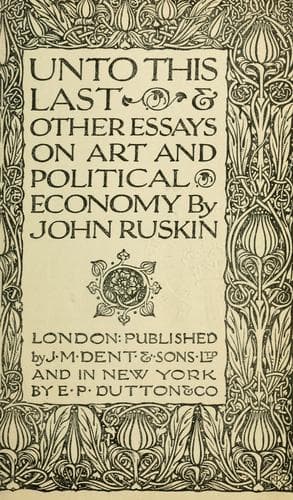
Unto This Last, and Other Essays on Political EconomyRuskin, John
General
Unto This Last, and Other Essays on Political Economy
Ruskin, John
Art; Economics
And on the other hand, the material value is apt to undermine the
manly character; so that it must be our work, in the issue, to examine
what evidence there is of the effect of wealth on the minds of its
possessors; also, what kind of person it is who usually sets himself
to obtain wealth, and succeeds in doing so; and whether the world owes
more gratitude to rich or to poor men, either for their moral
influence upon it, or for chief goods, discoveries, and practical
advancements. I may, however, anticipate future conclusions so far as
to state that in a community regulated only by laws of demand and
supply, but protected from open violence, the persons who become rich
are, generally speaking, industrious, resolute, proud, covetous,
prompt, methodical, sensible, unimaginative, insensitive, and
ignorant. The persons who remain poor are the entirely foolish, the
entirely wise,[52] the idle, the reckless, the humble, the thoughtful,
the dull, the imaginative, the sensitive, the well-informed, the
improvident, the irregularly and impulsively wicked, the clumsy knave,
the open thief, and the entirely merciful, just, and godly person.
[52] "[Greek: ho Zeus depou penetai.]"--_Arist. Plut._ 582. It
would but weaken the grand words to lean on the preceding
ones:--"[Greek: hoti tou Ploutou parecho beltionas andras,
kai ten gnomen, kai ten idean.]"
Thus far then of wealth. Next, we have to ascertain the nature of
PRICE; that is to say, of exchange value, and its expression by
currencies.
Note first, of exchange, there can be no _profit_ in it. It is only in
labour there can be profit--that is to say a "making in advance," or
"making in favour of" (from proficio). In exchange, there is only
advantage, _i.e._, a bringing of vantage or power to the exchanging
persons. Thus, one man, by sowing and reaping, turns one measure of
corn into two measures. That is Profit. Another by digging and
forging, turns one spade into two spades. That is Profit. But the man
who has two measures of corn wants sometimes to dig; and the man who
has two spades wants sometimes to eat:--They exchange the gained grain
for the gained tool; and both are the better for the exchange; but
though there is much advantage in the transaction, there is no profit.
Nothing is constructed or produced. Only that which had been before
constructed is given to the person by whom it can be used. If labour
is necessary to effect the exchange, that labour is in reality
involved in the production, and, like all other labour, bears profit.
Whatever number of men are concerned in the manufacture, or in the
conveyance, have share in the profit; but neither the manufacture nor
the conveyance are the exchange, and in the exchange itself there is
no profit.
Public-domain text, read in full here on John Shaqi.
Reviews
Reviews
No reviews yet
Be the first to share your thoughts on this work.
Elsewhere in the archive
Join the Discussion
Join the discussion
Sign in to leave a comment or review.
Sign InorCreate an account