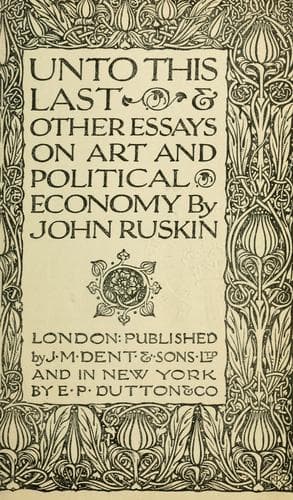
Unto This Last, and Other Essays on Political EconomyRuskin, John
General
Unto This Last, and Other Essays on Political Economy
Ruskin, John
Art; Economics
[66] The science which in modern days had been called Political
Economy is in reality nothing more than the investigation of
the phenomena of commercial operations. It has no connexion
with political economy, as understood and treated of by the
great thinkers of past ages; and as long as it is allowed
to pass under the same name, every word written by those
thinkers--and chiefly the words of Plato, Xenophon, Cicero,
and Bacon--must be either misunderstood or misapplied. The
reader must not, therefore, be surprised at the care and
insistence with which I have retained the literal and earliest
sense of all important terms used in these papers; for a word
is usually well made at the time it is first wanted; its
youngest meaning has in it the full strength of its youth;
subsequent senses are commonly warped or weakened; and as a
misused word always is liable to involve an obscured thought,
and all careful thinkers, either on this or any other subject,
are sure to have used their words accurately, the first
condition, in order to be able to avail ourselves of their
sayings at all, is a firm definition of terms.
The assumption which lies at the root of nearly all erroneous
reasoning on political economy--namely, that its object is to
accumulate money or exchangeable property--may be shown in few words
to be without foundation. For no economist would admit national
economy to be legitimate which proposed to itself only the building of
a pyramid of gold. He would declare the gold to be wasted, were it to
remain in the monumental form, and would say it ought to be employed.
But to what end? Either it must be used only to gain more gold, and
build a larger pyramid, or to some purpose other than the gaining of
gold. And this other purpose, however at first apprehended, will be
found to resolve itself finally into the service of man--that is to
say, the extension, defence, or comfort of his life. The golden
pyramid may perhaps be providently built, perhaps improvidently; but,
at all events, the wisdom or folly of the accumulation can only be
determined by our having first clearly stated the aim of all economy,
namely, the extension of life.
Public-domain text, read in full here on John Shaqi.
Reviews
Reviews
No reviews yet
Be the first to share your thoughts on this work.
Elsewhere in the archive
Join the Discussion
Join the discussion
Sign in to leave a comment or review.
Sign InorCreate an account