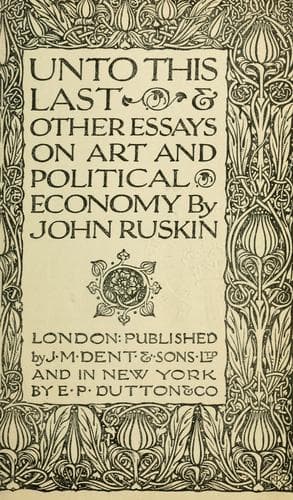
Unto This Last, and Other Essays on Political EconomyRuskin, John
General
Unto This Last, and Other Essays on Political Economy
Ruskin, John
Art; Economics
noblest type of man, and aim simply at maintaining the largest
possible number of persons of that class, and it will be found that
the largest possible number of every healthy subordinate class must
necessarily be produced also.
The perfect type of manhood, as just stated, involves the perfections
(whatever we may hereafter determine these to be) of his body,
affections, and intelligence. The material things, therefore,
which it is the object of political economy to produce and use
(or accumulate for use), are things which serve either to sustain
and comfort the body, or exercise rightly the affections and form the
intelligence.[67] Whatever truly serves either of these purposes is
"useful" to man, wholesome, healthful, helpful, or holy. By seeking
such things, man prolongs and increases his life upon the earth.
[67] It may be observed, in anticipation of some of our future
results, that while some conditions of the affections are
aimed at by the economist as final, others are necessary to
him as his own instruments: as he obtains them in greater or
less degree his own farther work becomes more or less
possible. Such, for instance, are the fortifying virtues,
which the wisest men of all time have, with more or less
distinctness, arranged under the general heads of Prudence,
or Discretion (the spirit which discerns and adopts
rightly); Justice (the spirit which rules and divides
rightly); Fortitude (the spirit which persists and endures
rightly); and Temperance (the spirit which stops and refuses
rightly); or in shorter terms still, the virtues which teach
how to consist, assist, persist, and desist. These outermost
virtues are not only the means of protecting and prolonging
life itself, but they are the chief guards or sources of the
material means of life, and are the visible governing powers
and princes of economy. Thus (reserving detailed statements
for the sequel) precisely according to the number of just
men in a nation, is their power of avoiding either intestine
or foreign war. All disputes may be peaceably settled, if a
sufficient number of persons have been trained to submit to
the principles of justice. The necessity for war is in
direct ratio to the number of unjust persons who are
incapable of determining a quarrel but by violence. Whether
the injustice take the form of the desire of dominion, or of
refusal to submit to it, or of lust of territory, or lust of
money, or of mere irregular passion and wanton will, the
result is economically the same;--loss of the quantity of
power and life consumed in repressing the injustice, as well
as of that requiring to be repressed, added to the material
and moral destruction caused by the fact of war. The early
Public-domain text, read in full here on John Shaqi.
Reviews
Reviews
No reviews yet
Be the first to share your thoughts on this work.
Elsewhere in the archive
Join the Discussion
Join the discussion
Sign in to leave a comment or review.
Sign InorCreate an account