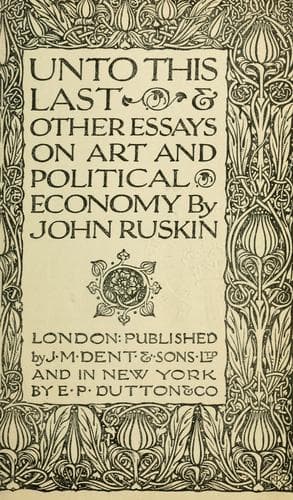
Unto This Last, and Other Essays on Political EconomyRuskin, John
General
Unto This Last, and Other Essays on Political Economy
Ruskin, John
Art; Economics
And, indeed, it is only through evil conduct, wilfully persisted in,
that there is any embarrassment either in the theory or the working of
currency. No exchequer is ever embarrassed, nor is any financial
question difficult of solution, when people keep their practice
honest, and their heads cool. But when Governments lose all office of
pilotage, protection, scrutiny, and witness; and live only in
magnificence of proclaimed larceny, effulgent mendacity, and polished
mendicity; or when the people choosing Speculation (the S usual
redundant in the spelling) instead of Toil, pursue no dishonesty with
chastisement, that each may with impunity take his dishonest turn; and
enlarge their lust of wealth through ignorance of its use, making
their harlot of the dust, and setting Earth, the Mother, at the mercy
of Earth, the Destroyer, so that she has to seek in hell the children
she left playing in the meadows,--there are no tricks of financial
terminology that will save them; all signature and mintage do but
magnify the ruin they retard; and even the riches that remain,
stagnant or current, change only from the slime of Avernus to the sand
of Phlegethon;--quicksand at the embouchure;--land fluently
recommended by recent auctioneers as "eligible for building leases."
Finally, then, the power of true currency is fourfold.
1. Credit power. Its worth in exchange, dependent on public opinion of
the stability and honesty of the issuer.
2. Real worth. Supposing the gold, or whatever else the currency
expressly promises, to be required from the issuer, for all his notes;
and that the call cannot be met in full. Then the actual worth of the
document (whatever its credit power) would be, and its actual worth at
any moment is to be defined as being, what the division of the assets
of the issuer, and his subsequent will work, would produce for it.
3. The exchange power of its base. Granting that we can get five
pounds in gold for our note, it remains a question how much of other
things we can get for five pounds in gold. The more of other things
exist, and the less gold, the greater this power.
4. The power over labour, exercised by the given quantity of the base,
or of the things to be got for it. The question in this case is, how
much work, and (question of questions) whose work, is to be had for
the food which five pounds will buy. This depends on the number of the
population; on their gifts, and on their dispositions, with which,
down to their slightest humours and up to their strongest impulses,
the power of the currency varies; and in this last of its ranges,--the
range of passion, price, or praise (converso in pretium Deo), is at
once least, and greatest.
Public-domain text, read in full here on John Shaqi.
Reviews
Reviews
No reviews yet
Be the first to share your thoughts on this work.
Elsewhere in the archive
Join the Discussion
Join the discussion
Sign in to leave a comment or review.
Sign InorCreate an account