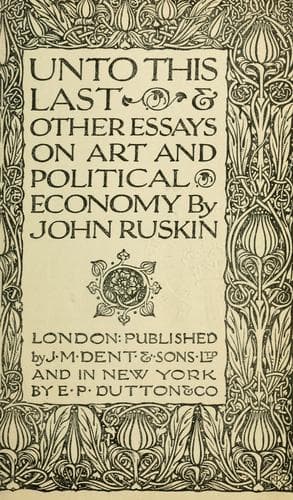
Unto This Last, and Other Essays on Political EconomyRuskin, John
General
Unto This Last, and Other Essays on Political Economy
Ruskin, John
Art; Economics
[94] They are (up to the amount of the currency) simply creditors
and debtors--the commercial types of the two great sects of
humanity which those words describe; for debt and credit are
of course merely the mercantile forms of the words "duty"
and "creed," which give the central ideas: only it is more
accurate to say "faith" than "creed," because creed has been
applied carelessly to mere forms of words. Duty properly
signifies whatever in substance or act one person owes to
another, and faith the other's trust in his rendering it.
The French "devoir" and "foi" are fuller and clearer words
than ours; for, faith being the passive of fact, foi comes
straight through fides from fio; and the French keep the
group of words formed from the infinitive--fieri, "se fier,"
"se defier," "defiance," and the grand following "defi." Our
English "affiance," "defiance," "confidence," "diffidence,"
retain accurate meanings; but our "faithful" has become
obscure, from being used for "faithworthy," as well as "full
of faith." "His name that sat on him was called Faithful and
True."
Trust is the passive of true saying, as faith is the passive
of due doing; and the right learning of these etymologies,
which are in the strictest sense only to be learned "by
heart," is of considerably more importance to the youth of a
nation than its reading and ciphering.
[95] For example, suppose an active peasant, having got his
ground into good order and built himself a comfortable
house, finding still time on his hands, sees one of his
neighbours little able to work, and ill lodged, and offers
to build him also a house, and to put his land in order, on
condition of receiving for a given period rent for the
building and tithe of the fruits. The offer is accepted, and
a document given promissory of rent and tithe. This note is
money. It can only be good money if the man who has incurred
the debt so far recovers his strength as to be able to take
advantage of the help he has received, and meet the demand
of the note; if he lets his house fall to ruin, and his
field to waste, his promissory note will soon be valueless:
but the existence of the note at all is a consequence of his
not having worked so stoutly as the other. Let him gain as
much as to be able to pay back the entire debt; the note is
cancelled and we have two rich store-holders and no
currency.
Public-domain text, read in full here on John Shaqi.
Reviews
Reviews
No reviews yet
Be the first to share your thoughts on this work.
Elsewhere in the archive
Join the Discussion
Join the discussion
Sign in to leave a comment or review.
Sign InorCreate an account