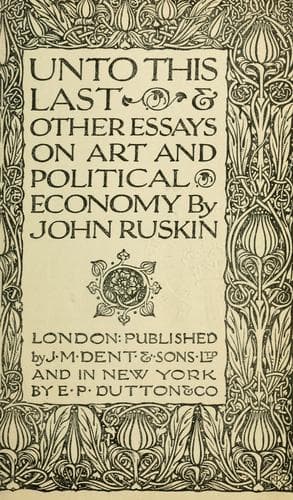
Unto This Last, and Other Essays on Political EconomyRuskin, John
General
Unto This Last, and Other Essays on Political Economy
Ruskin, John
Art; Economics
Of Shakespeare's names I will afterwards speak at more
length: they are curiously--often barbarously--mixed out of
various traditions and languages. Three of the clearest in
meaning have been already noticed. Desdemona, "[Greek:
dysdaimonia]," "miserable fortune," is also plain enough.
Othello is, I believe, "the careful"; all the calamity of
the tragedy arising from the single flaw and error in his
magnificently collected strength. Ophelia,
"serviceableness," the true lost wife of Hamlet, is marked
as having a Greek name by that last word of her, where her
gentle preciousness is opposed to the uselessness of the
churlish clergy--"A ministering angel shall my sister be
when thou liest howling." Hamlet is, I believe, connected in
some way with "homely," the entire event of the tragedy
turning on betrayal of home duty. Hermione ([Greek: herma]),
"pillar-like" ([Greek: he eidos eche chryses Aphrodites]).
Titania ([Greek: titene]), "the queen;" Benedict and
Beatrice, "blessed and blessing;" Valentine and Proteus,
enduring (or strong) (valens) and changeful. Iago and
Iachimo have evidently the same root--probably the Spanish
Iago, Jacob, "the supplanter." Leonatus, and other such
names are interpreted, or played with, in the plays
themselves. For the interpretation of Sycorax, and reference
to her raven's feather, I am indebted to Mr. John R. Wise.
I should dwell, even in these prefatory papers, at somewhat more
length on this matter, had not all I would say, been said (already in
vain) by Carlyle, in the first of the "Latter-Day Pamphlets," which I
commend to the reader's gravest reading: together with that as much
neglected, and still more immediately needed, on model prisons, and
with the great chapter on "Permanence" (fifth of the last section of
"Past and Present"), which sums, what is known, and foreshadows,--or
rather fore-lights, all that is to be learned, of National Discipline.
I have only here farther to examine the nature of one world-wide and
everlasting form of slavery, wholesome in use, deadly in abuse--the
service of the rich by the poor.
Public-domain text, read in full here on John Shaqi.
Reviews
Reviews
No reviews yet
Be the first to share your thoughts on this work.
Elsewhere in the archive
Join the Discussion
Join the discussion
Sign in to leave a comment or review.
Sign InorCreate an account