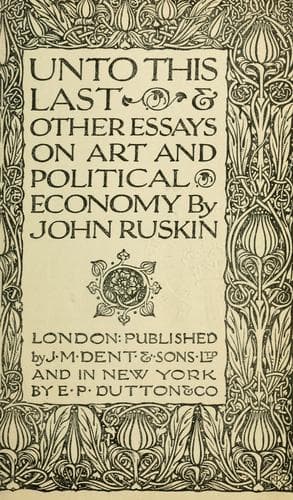
Unto This Last, and Other Essays on Political EconomyRuskin, John
General
Unto This Last, and Other Essays on Political Economy
Ruskin, John
Art; Economics
I have put the two cases in simplicity, and to some extremity. But
though in more complex and qualified operation, all the relations of
society are but the expansion of these two typical sequences of
conduct and result. I do not say, observe, that the first procedure is
entirely right; still less, that the second is wholly wrong. Servants
and artists, and splendour of habitation and retinue, have all their
use, propriety and office. I only wish the reader to understand
clearly what they cost; that the condition of having them is the
subjection to you of a certain number of imprudent or unfortunate
persons (or, it may be, more fortunate than their master), over whose
destinies you exercise a boundless control. "Riches" mean eternally
and essentially this; and may heaven send at last a time when those
words of our best-reputed economist shall be true, and we shall indeed
"all know what it is to be rich;" that is to be slave-master over
farthest earth, and over all ways and thoughts of men. Every operative
you employ is your true servant: distant or near, subject to your
immediate orders, or ministering to your widely-communicated
caprice--for the pay he stipulates, or the price he tempts,--all are
alike under this great dominion of the gold. The milliner who makes
the dress is as much a servant (more so, in that she uses more
intelligence in the service) as the maid who puts it on; the carpenter
who smoothes the door, as the footman who opens it; the tradesmen who
supply the table, as the labourers and sailors who supply the
tradesmen. Why speak of these lower services? Painters and singers
(whether of note or rhyme), jesters and story-tellers, moralists,
historians, priests--so far as these, in any degree, paint, or sing,
or tell their tale, or charm their charm, or "perform" their rite, for
pay, in so far they are all slaves; abject utterly, if the service be
for pay only; abject less and less in proportion to the degrees of
love and wisdom which enter into their duty, or can enter into it,
according as their function is to do the bidding and the work of a
man;--or to amuse, tempt, and deceive a child.
There may be thus, and, to a certain extent, there always is, a
government of the rich by the poor, as of the poor by the rich; but
the latter is the prevailing and necessary one, and it consists,
observe, of two distinct functions,--the collection of the profits of
labour from those who would have misused them, and the administration
of those profits for the service either of the same person in future,
or of others; or, as is more frequently the case in modern times, for
the service of the collector himself.
Public-domain text, read in full here on John Shaqi.
Reviews
Reviews
No reviews yet
Be the first to share your thoughts on this work.
Elsewhere in the archive
Join the Discussion
Join the discussion
Sign in to leave a comment or review.
Sign InorCreate an account