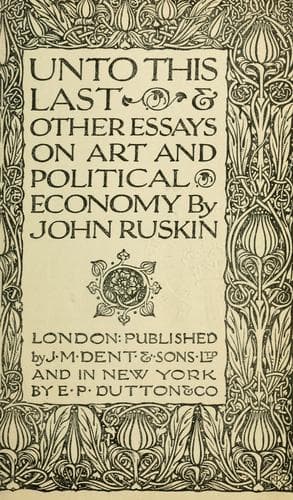
Unto This Last, and Other Essays on Political EconomyRuskin, John
General
Unto This Last, and Other Essays on Political Economy
Ruskin, John
Art; Economics
"Nay," I can imagine some of the more generous among you, exclaiming,
"we will not trouble you to disprove that objection; of course it is a
selfish and base one: good art, as well as other good things, ought to
be made as cheap as possible, and put as far as we can within the
reach of everybody."
Pardon me, I am not prepared to admit that. I rather side with the
selfish objectors, and believe that art ought not to be made cheap,
beyond a certain point; for the amount of pleasure that you can
receive from any great work, depends wholly on the quantity of
attention and energy of mind you can bring to bear upon it. Now, that
attention and energy depend much more on the freshness of the thing
than you would at all suppose; unless you very carefully studied the
movements of your own minds. If you see things of the same kind and of
equal value very frequently, your reverence for them is infallibly
diminished, your powers of attention get gradually wearied, and your
interest and enthusiasm worn out; and you cannot in that state bring
to any given work the energy necessary to enjoy it. If, indeed, the
question were only between enjoying a great many pictures each a
little, or one picture very much, the sum of enjoyment being in each
case the same, you might rationally desire to possess rather the
larger quantity, than the small; both because one work of art always
in some sort illustrates another, and because quantity diminishes the
chances of destruction. But the question is not a merely arithmetical
one of this kind. Your fragments of broken admirations will not, when
they are put together, make up one whole admiration; two and two, in
this case, do not make four, nor anything like four. Your good
picture, or book, or work of art of any kind, is always in some degree
fenced and closed about with difficulty. You may think of it as of a
kind of cocoa-nut, with very often rather an unseemly shell, but good
milk and kernel inside. Now, if you possess twenty cocoa-nuts, and
being thirsty, go impatiently from one to the other, giving only a
single scratch with the point of your knife to the shell of each, you
will get no milk from all the twenty. But if you leave nineteen of
them alone, and give twenty cuts to the shell of one, you will get
through it, and at the milk of it. And the tendency of the human mind
is always to get tired before it has made its twenty cuts; and to try
another nut; and moreover, even if it has perseverance enough to crack
its nuts, it is sure to try to eat too many, and so choke itself.
Hence, it is wisely appointed for us that few of the things we desire
can be had without considerable labour, and at considerable intervals
of time. We cannot generally get our dinner without working for it,
and that gives us appetite for it; we cannot get our holiday without
waiting for it, and that gives us zest for it; and we ought not to get
our picture without paying for it, and that gives us a mind to look at
it.
Public-domain text, read in full here on John Shaqi.
Reviews
Reviews
No reviews yet
Be the first to share your thoughts on this work.
Join the Discussion
Join the discussion
Sign in to leave a comment or review.
Sign InorCreate an account