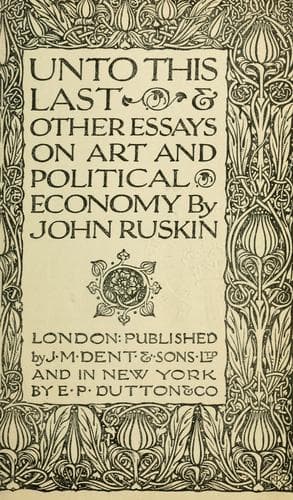
Unto This Last, and Other Essays on Political EconomyRuskin, John
General
Unto This Last, and Other Essays on Political Economy
Ruskin, John
Art; Economics
Nay, I will even go so far as to say, that we ought not to get
books too cheaply. No book, I believe, is ever worth half so much to
its reader as one that has been coveted for a year at a bookstall, and
bought out of saved half-pence; and perhaps a day or two's fasting.
That's the way to get at the cream of a book. And I should say more on
this matter, and protest as energetically as I could against the
plague of cheap literature, with which we are just now afflicted, but
that I fear your calling me to order, as being unpractical, because I
don't quite see my way at present to making everybody fast for their
books. But one may see that a thing is desirable and possible, even
though one may not at once know the best way to it--and in my island
of Barataria, when I get it well into order, I assure you no book
shall be sold for less than a pound sterling; if it can be published
cheaper than that, the surplus shall all go into my treasury, and save
my subjects taxation in other directions; only people really poor, who
cannot pay the pound, shall be supplied with the books they want for
nothing, in a certain limited quantity. I haven't made up my mind
about the number yet, and there are several other points in the system
yet unsettled; when they are all determined, if you will allow me, I
will come and give you another lecture, on the political economy of
literature.[11]
[11] See note 6th, in Addenda [p. 104].
Meantime, returning to our immediate subject, I say to my generous
hearers, who want to shower Titians and Turners upon us, like falling
leaves, "Pictures ought not to be too cheap;" but in much stronger
tone I would say to those who want to keep up the prices of pictorial
property, that pictures ought not to be too dear, that is to say, not
as dear as they are. For, as matters at present stand, it is wholly
impossible for any man in the ordinary circumstances of English life
to possess himself of a piece of great art. A modern drawing of
average merit, or a first-class engraving, may perhaps, not without
some self-reproach, be purchased out of his savings by a man of narrow
income; but a satisfactory example of first-rate art--masterhands'
work--is wholly out of his reach. And we are so accustomed to look
upon this as the natural course and necessity of things, that we never
set ourselves in any wise to diminish the evil; and yet it is an evil
perfectly capable of diminution. It is an evil precisely similar in
kind to that which existed in the middle ages, respecting good books,
and which everybody then, I suppose, thought as natural as we do now
our small supply of good pictures. You could not then study the work
of a great historian, or great poet, any more than you can now study
that of a great painter, but at heavy cost. If you wanted a book, you
had to get it written out for you, or to write it out for yourself.
But printing came, and the poor man may read his Dante and his Homer;
and Dante and Homer are none the worse for that.
Public-domain text, read in full here on John Shaqi.
Reviews
Reviews
No reviews yet
Be the first to share your thoughts on this work.
Join the Discussion
Join the discussion
Sign in to leave a comment or review.
Sign InorCreate an account