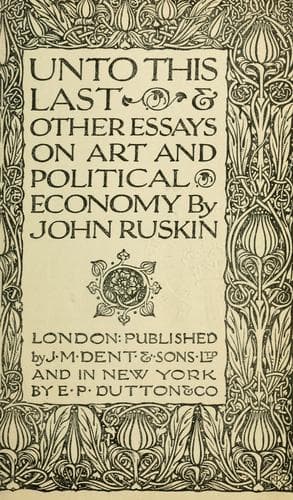
Unto This Last, and Other Essays on Political EconomyRuskin, John
General
Unto This Last, and Other Essays on Political Economy
Ruskin, John
Art; Economics
I must begin a little apparently wide of the mark, and ask you to
reflect if there is any way in which we waste money more in England,
than in building fine tombs? Our respect for the dead, when they are
_just_ dead, is something wonderful, and the way we show it more
wonderful still. We show it with black feathers and black horses; we
show it with black dresses and bright heraldries; we show it with
costly obelisks and sculptures of sorrow, which spoil half of our most
beautiful cathedrals. We show it with frightful gratings and vaults,
and lids of dismal stone, in the midst of the quiet grass; and last,
and not least, we show it by permitting ourselves to tell any number
of lies we think amiable or credible, in the epitaph. This feeling is
common to the poor as well as the rich, and we all know how many a
poor family will nearly ruin themselves, to testify their respect for
some member of it in his coffin, whom they never much cared for when
he was out of it; and how often it happens that a poor old woman will
starve herself to death, in order that she may be respectably buried.
Now, this being one of the most complete and special ways of wasting
money;--no money being less productive of good, or of any percentage
whatever, than that which we shake away from the ends of undertakers'
plumes--it is of course the duty of all good economists, and kind
persons, to prove and proclaim continually, to the poor as well as the
rich, that respect for the dead is not really shown by laying great
stones on them to tell us where they are laid; but by remembering
where they are laid, without a stone to help us; trusting them to the
sacred grass and saddened flowers; and still more, that respect and
love are shown to them, not by great monuments to them which we build
with _our_ hands, but by letting the monuments stand, which they built
with _their own_. And this is the point now in question.
Observe, there are two great reciprocal duties concerning industry,
constantly to be exchanged between the living and the dead. We, as we
live and work, are to be always thinking of those who are to come
after us; that what we do may be serviceable, as far as we can make it
so, to them as well as to us. Then, when we die, it is the duty of
those who come after us to accept this work of ours with thanks and
remembrance, not thrusting it aside or tearing it down the moment they
think they have no use for it. And each generation will only be happy
or powerful to the pitch that it ought to be, in fulfilling these two
duties to the Past and the Future. Its own work will never be rightly
done, even for itself--never good, or noble, or pleasurable to its own
eyes--if it does not prepare it also for the eyes of generations yet
to come. And its own possessions will never be enough for it, and its
own wisdom never enough for it, unless it avails itself gratefully and
tenderly of the treasures and the wisdom bequeathed to it by its
ancestors.
Public-domain text, read in full here on John Shaqi.
Reviews
Reviews
No reviews yet
Be the first to share your thoughts on this work.
Elsewhere in the archive
Join the Discussion
Join the discussion
Sign in to leave a comment or review.
Sign InorCreate an account