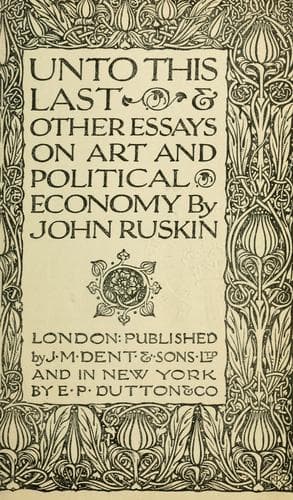
Unto This Last, and Other Essays on Political EconomyRuskin, John
General
Unto This Last, and Other Essays on Political Economy
Ruskin, John
Art; Economics
For, be assured, that all the best things and treasures of this world
are not to be produced by each generation for itself; but we are all
intended, not to carve our work in snow that will melt, but each and
all of us to be continually rolling a great white gathering snowball,
higher and higher--larger and larger--along the Alps of human power.
Thus the science of nations is to be accumulative from father to son:
each learning a little more and a little more; each receiving all that
was known, and adding its own gain: the history and poetry of nations
are to be accumulative; each generation treasuring the history and the
songs of its ancestors, adding its own history and its own songs: and
the art of nations is to be accumulative, just as science and history
are; the work of living men not superseding, but building itself upon
the work of the past. Nearly every great and intellectual race of the
world has produced, at every period of its career, an art with some
peculiar and precious character about it, wholly unattainable by any
other race, and at any other time; and the intention of Providence
concerning that art, is evidently that it should all grow together
into one mighty temple; the rough stones and the smooth all finding
their place, and rising, day by day, in richer and higher pinnacles to
heaven.
Now, just fancy what a position the world, considered as one great
workroom--one great factory in the form of a globe--would have been in
by this time, if it had in the least understood this duty, or been
capable of it. Fancy what we should have had around us now, if,
instead of quarrelling and fighting over their work, the nations had
aided each other in their work, or if even in their conquests, instead
of effacing the memorials of those they succeeded and subdued, they
had guarded the spoils of their victories. Fancy what Europe would be
now, if the delicate statues and temples of the Greeks,--if the broad
roads and massy walls of the Romans,--if the noble and pathetic
architecture of the middle ages, had not been ground to dust by mere
human rage. You talk of the scythe of Time, and the tooth of Time: I
tell you, Time is scytheless and toothless; it is we who gnaw like the
worm--we who smite like the scythe. It is ourselves who
abolish--ourselves who consume: we are the mildew, and the flame, and
the soul of man is to its own work as the moth, that frets when it
cannot fly, and as the hidden flame that blasts where it cannot
illumine. All these lost treasures of human intellect have been wholly
destroyed by human industry of destruction; the marble would have
stood its two thousand years as well in the polished statue as in the
Parian cliff; but we men have ground it to powder, and mixed it with
our own ashes. The walls and the ways would have stood--it is we who
have left not one stone upon another, and restored its pathlessness to
the desert; the great cathedrals of old religion would have stood--it
Public-domain text, read in full here on John Shaqi.
Reviews
Reviews
No reviews yet
Be the first to share your thoughts on this work.
Elsewhere in the archive
Join the Discussion
Join the discussion
Sign in to leave a comment or review.
Sign InorCreate an account