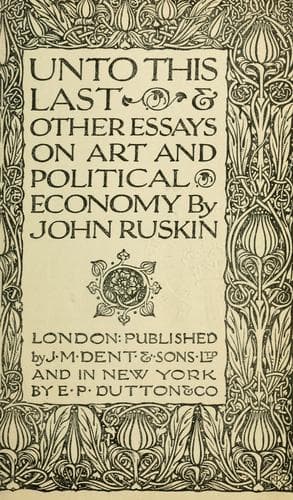
Unto This Last, and Other Essays on Political EconomyRuskin, John
General
Unto This Last, and Other Essays on Political Economy
Ruskin, John
Art; Economics
is we who have dashed down the carved work with axes and hammers, and
bid the mountain-grass bloom upon the pavement, and the sea-winds
chaunt in the galleries.
You will perhaps think all this was somehow necessary for the
development of the human race. I cannot stay now to dispute that,
though I would willingly; but do you think it is _still_ necessary for
that development? Do you think that in this nineteenth century it is
still necessary for the European nations to turn all the places where
their principal art-treasures are into battle-fields? For that is what
they are doing even while I speak; the great firm of the world is
managing its business at this moment, just as it has done in past
time. Imagine what would be the thriving circumstances of a
manufacturer of some delicate produce--suppose glass, or china--in
whose workshop and exhibition rooms all the workmen and clerks began
fighting at least once a day, first blowing off the steam, and
breaking all the machinery they could reach; and then making
fortresses of all the cupboards, and attacking and defending the
show-tables, the victorious party finally throwing everything they
could get hold of out of the window, by way of showing their triumph,
and the poor manufacturer picking up and putting away at last a cup
here and a handle there. A fine prosperous business that would be,
would it not? and yet that is precisely the way the great
manufacturing firm of the world carries on its business.
It has so arranged its political squabbles for the last six or seven
hundred years, that not one of them could be fought out but in the
midst of its most precious art; and it so arranges them to this day.
For example, if I were asked to lay my finger, in a map of the world,
on the spot of the world's surface which contained at this moment the
most singular concentration of art-teaching and art-treasure, I should
lay it on the name of the town of Verona. Other cities, indeed,
contain more works of carriageable art, but none contain so much of
the glorious local art, and of the springs and sources of art, which
can by no means be made subjects of package or porterage, nor, I
grieve to say, of salvage. Verona possesses, in the first place, not
the largest, but the most perfect and intelligible Roman amphitheatre
that exists, still unbroken in circle of step, and strong in
succession of vault and arch: it contains minor Roman monuments,
gateways, theatres, baths, wrecks of temples, which give the streets
of its suburbs a character of antiquity unexampled elsewhere, except
in Rome itself. But it contains, in the next place, what Rome does not
contain--perfect examples of the great twelfth-century Lombardic
architecture, which was the root of all the mediaeval art of Italy,
without which no Giottos, no Angelicos, no Raphaels would have been
possible: it contains that architecture, not in rude forms, but in the
most perfect and loveliest types it ever attained--contains those, not
Public-domain text, read in full here on John Shaqi.
Reviews
Reviews
No reviews yet
Be the first to share your thoughts on this work.
Elsewhere in the archive
Join the Discussion
Join the discussion
Sign in to leave a comment or review.
Sign InorCreate an account