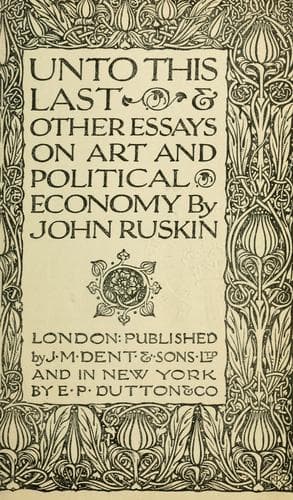
Unto This Last, and Other Essays on Political EconomyRuskin, John
General
Unto This Last, and Other Essays on Political Economy
Ruskin, John
Art; Economics
walls, and for ever afterwards the meaning of any word would be fixed
in a boy's mind in the best possible way. Is it a question of
classical dress--what a tunic was like, or a chlamys, or a peplus? At
this day, you have to point to some vile woodcut, in the middle of a
dictionary page, representing the thing hung upon a stick, but then,
you would point to a hundred figures, wearing the actual dress, in its
fiery colours, in all actions of various stateliness or strength; you
would understand at once how it fell round the people's limbs as they
stood, how it drifted from their shoulders as they went, how it veiled
their faces as they wept, how it covered their heads in the day of
battle. _Now_, if you want to see what a weapon is like, you refer, in
like manner, to a numbered page, in which there are spear-heads in
rows, and sword-hilts in symmetrical groups; and gradually the boy
gets a dim mathematical notion how one scymitar is hooked to the right
and another to the left, and one javelin has a knob to it and another
none: while one glance at your good picture would show him,--and the
first rainy afternoon in the schoolroom would for ever fix in his
mind,--the look of the sword and spear as they fell or flew; and how
they pierced, or bent, or shattered--how men wielded them, and how men
died by them. But far more than all this, is it a question not of
clothes or weapons, but of men? how can we sufficiently estimate the
effect on the mind of a noble youth, at the time when the world opens
to him, of having faithful and touching representations put before him
of the acts and presences of great men--how many a resolution, which
would alter and exalt the whole course of his after-life, might be
formed, when in some dreamy twilight he met, through his own tears,
the fixed eyes of those shadows of the great dead, unescapable and
calm, piercing to his soul; or fancied that their lips moved in dread
reproof or soundless exhortation. And if but for one out of many this
were true--if yet, in a few, you could be sure that such influence had
indeed changed their thoughts and destinies, and turned the eager and
reckless youth, who would have cast away his energies on the
race-horse or the gambling-table, to that noble life-race, that holy
life-hazard, which should win all glory to himself and all good to his
country--would not that, to some purpose, be "political economy of
art?"
Public-domain text, read in full here on John Shaqi.
Reviews
Reviews
No reviews yet
Be the first to share your thoughts on this work.
Elsewhere in the archive
Join the Discussion
Join the discussion
Sign in to leave a comment or review.
Sign InorCreate an account