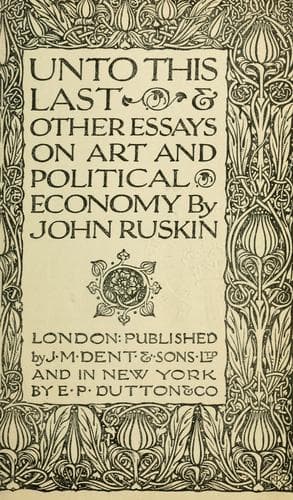
Unto This Last, and Other Essays on Political EconomyRuskin, John
General
Unto This Last, and Other Essays on Political Economy
Ruskin, John
Art; Economics
Supposing half a dozen or a dozen men were cast ashore from a wreck on
an uninhabited island and left to their own resources, one of course,
according to his capacity, would be set to one business and one to
another; the strongest to dig and to cut wood, and to build huts for
the rest: the most dexterous to make shoes out of bark and coats out
of skins; the best educated to look for iron or lead in the rocks, and
to plan the channels for the irrigation of the fields. But though
their labours were thus naturally severed, that small group of
shipwrecked men would understand well enough that the speediest
progress was to be made by helping each other,--not by opposing each
other; and they would know that this help could only be properly given
so long as they were frank and open in their relations, and the
difficulties which each lay under properly explained to the rest. So
that any appearance of secresy or separateness in the actions of any
of them would instantly, and justly, be looked upon with suspicion by
the rest, as the sign of some selfish or foolish proceeding on the
part of the individual. If, for instance, the scientific man were
found to have gone out at night, unknown to the rest, to alter the
sluices, the others would think, and in all probability rightly think,
that he wanted to get the best supply of water to his own field; and
if the shoemaker refused to show them where the bark grew which he
made the sandals of, they would naturally think, and in all
probability rightly think, that he didn't want them to see how much
there was of it, and that he meant to ask from them more corn and
potatoes in exchange for his sandals than the trouble of making them
deserved. And thus, although each man would have a portion of time to
himself in which he was allowed to do what he chose without let or
inquiry,--so long as he was working in that particular business which
he had undertaken for the common benefit, any secresy on his part
would be immediately supposed to mean mischief; and would require to
be accounted for, or put an end to: and this all the more because,
whatever the work might be, certainly there would be difficulties
about it which, when once they were well explained, might be more or
less done away with by the help of the rest; so that assuredly every
one of them would advance with his labour not only more happily, but
more profitably and quickly, by having no secrets, and by frankly
bestowing, and frankly receiving, such help as lay in his way to get
or to give.
Public-domain text, read in full here on John Shaqi.
Reviews
Reviews
No reviews yet
Be the first to share your thoughts on this work.
Elsewhere in the archive
Join the Discussion
Join the discussion
Sign in to leave a comment or review.
Sign InorCreate an account