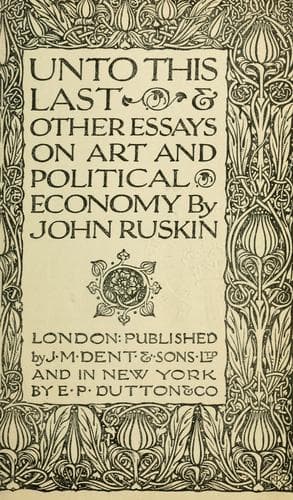
Unto This Last, and Other Essays on Political EconomyRuskin, John
General
Unto This Last, and Other Essays on Political Economy
Ruskin, John
Art; Economics
But there is injustice; and, let us trust, one of which honourable men
will at no very distant period disdain to be guilty. In some degree,
however, it is indeed not unjust; in some degree it is necessary and
intended. It is assuredly just that idleness should be surpassed by
energy; that the widest influence should be possessed by those who are
best able to wield it; and that a wise man, at the end of his career,
should be better off than a fool. But for that reason, is the fool to
be wretched, utterly crushed down, and left in all the suffering which
his conduct and capacity naturally inflict?--Not so. What do you
suppose fools were made for? That you might tread upon them, and
starve them, and get the better of them in every possible way? By no
means. They were made that wise people might take care of them. That
is the true and plain fact concerning the relations of every strong
and wise man to the world about him. He has his strength given him,
not that he may crush the weak, but that he may support and guide
them. In his own household he is to be the guide and the support of
his children; out of his household he is still to be the father, that
is, the guide and support of the weak and the poor; not merely of the
meritoriously weak and the innocently poor, but of the guiltily and
punishably poor; of the men who ought to have known better--of the
poor who ought to be ashamed of themselves. It is nothing to give
pension and cottage to the widow who has lost her son; it is nothing
to give food and medicine to the workman who has broken his arm, or
the decrepit woman wasting in sickness. But it is something to use
your time and strength to war with the waywardness and thoughtlessness
of mankind; to keep the erring workman in your service till you have
made him an unerring one; and to direct your fellow-merchant to the
opportunity which his dullness would have lost. This is much; but it
is yet more, when you have fully achieved the superiority which is due
to you, and acquired the wealth which is the fitting reward of your
sagacity, if you solemnly accept the responsibility of it, as it is
the helm and guide of labour far and near. For you who have it in your
hands, are in reality the pilots of the power and effort of the
State.[16] It is entrusted to you as an authority to be used for good
or evil, just as completely as kingly authority was ever given to a
prince, or military command to a captain. And, according to the
quantity of it that you have in your hands you are the arbiters of the
will and work of England; and the whole issue, whether the work of the
State shall suffice for the State or not, depends upon you. You may
stretch out your sceptre over the heads of the English labourers, and
say to them, as they stoop to its waving, "Subdue this obstacle that
has baffled our fathers, put away this plague that consumes our
children; water these dry places, plough these desert ones, carry this
Public-domain text, read in full here on John Shaqi.
Reviews
Reviews
No reviews yet
Be the first to share your thoughts on this work.
Elsewhere in the archive
Join the Discussion
Join the discussion
Sign in to leave a comment or review.
Sign InorCreate an account