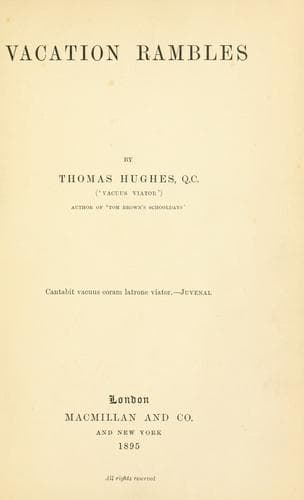
Europe -- Description and travel; United States -- Description and travel
He knows J------ well, and insisted on carrying us off to his island
that night, that we might attend a huge campmeeting on a neighbouring
island on Sunday. So he drove up here with us and we packed--the dear
Professor agreeing that we ought to do it--went down sixty miles by
rail, slept on his yacht, and found ourselves in the morning at his
wharf on the island. Your second letter came to hand from Cromer when we
returned here, and has as usual lighted up my life.
Cambridge, 2nd September 1870.
We are off this afternoon for Newport on our way to New York, and so
south and west. The express man will be here directly for my luggage,
which will be a little curtailed, as these dear kind people insist on
our returning, and leaving all we don’t want in our rooms. So I shall
drop my beaver, leaving it with the most serious admonitions in the
charge of Rose, the Irish girl, who is a character. I will now take up
the thread of my story, merely remarking that what you seem to think
a dull catalogue of small doings at a small watering-place is quite
unspeakably delightful to me away here. On the wharf at Nashont Island
we found the two young F------s, the elder a colonel in the war, and
five months a prisoner in the South, the younger, Malcolm, just left
college. I never saw two finer young men, both of them models of
strength. They had come down to meet us and bathe, so we stopped and
had a splendid header off the wharf and a swim in the bay, after careful
inquiries by R------ as to sharks, to which young F------ replied with
a twinkle in his eye, that they didn’t lose _many_ friends that way. We
walked up to the house after our dip, a large wooden building, with deep
verandahs and sun-blinds, furnished quite plainly, even roughly, but
capable of holding nearly any number of people. We were about eighteen
at breakfast: Mrs. F------ a handsome, clever, elderly lady, born a
Quaker, and with their charm of manner, who made tea for the party, and
on whose right I sat. Opposite her was her husband with Mrs. L------,
the young widow of Lowell’s nephew Charles, the famous soldier, on his
left, and therefore opposite me. On my right, a young woman, a cousin of
the F------s, a Mrs. P------, whose husband sat down towards the end of
the table, the manager of a Western railway, who has given us free
passes over his line. Colonel F------, the eldest son, was Lowell’s
major, and served with distinction in the war, in which he was taken
prisoner, and spent five months in Southern prisons; his wife, a buxom
young woman with very good eyes, is Emerson’s daughter, and her brother,
a bright boy of twenty-two or twenty-three, was near me. There were two
daughters of the family, and two other girls and several boys, all
pleasant and easy in hand; but the gem of the party was the young widow.
She is not actually pretty, but with a face full of the nobleness of
sorrow, which has done its work. I have seldom been more touched than in
Public-domain text, read in full here on John Shaqi.
Reviews
Reviews
No reviews yet
Be the first to share your thoughts on this work.
Elsewhere in the archive
Join the Discussion
Join the discussion
Sign in to leave a comment or review.
Sign InorCreate an account