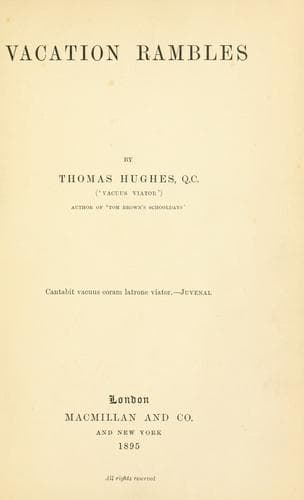
Europe -- Description and travel; United States -- Description and travel
all the judges, had the _entrée_ to their private rooms, and, especially
in the case of the Judges of the Supreme Court, scarcely ever failed to
avail himself of this privilege when the Courts were sitting. He had a
capital cook and good horses, which were always freely at the service
of the representatives of justice. Gradually it began to be quietly
understood, no one quite knew how, amongst suitors, that it was
possible, and very desirable, to interest the gentleman in question in
their cases. He was ready, it would seem, to accept a retaining-fee.
His charge was fixed at a very moderate percentage on the value of the
property in dispute, which nobody need pay unless they thought it worth
while. Moreover, the system was one of “No cure, no pay.” He gave every
one an acknowledgment in writing of the amount paid in their respective
cases, with an undertaking to return the full sum in the event of their
proving unsuccessful. It therefore naturally appeared to the average
Western suitor about as profitable an investment as he could make.
Strange to say, this queer practice seems to have gone on for years, and
no shadow of suspicion ever fell on this “principal citizen,” whatever
might have been the case as to his friends the judges. The strong
individuality and secretiveness which marks the Western character may
probably account for the fact that during his life no one would seem to
have taken any public notice of this peculiar industry. If a suitor was
successful, he was content; if not, he got back his money, and it was
nobody’s affair but his own. Well, the good man died, and was buried,
and his executors, in administering his estate, were astonished to
find bundles of receipts from suitors of all classes and degrees,
acknowledging the repayment to them of sums varying in amount from $5
and upwards “in the case of Brown v. Jones,” “in the matter of United
States v. Robinson,” “_ex parte_ White,” etc. This led to further
inquiry, and the facts came ~ gradually to light. The sagacious testator
had, in fact, taken his percentage _from both sides_ in almost every
case of any importance which had been heard in the Courts for years. He
had never mentioned suit or suitor to any of the judges, his visits to
them being simply for the purpose of asking them to dinner, offering
them a drive, or a bed if they were on circuit away from home, or
interchanging gossip as to stocks, railways, or public affairs. And so
for years five honest men had been presiding in the different Courts,
entirely innocent of the fact that almost every suitor was looking upon
each of them as a person who had received valuable consideration for
deciding in his favour. I own that my experience, though, of course,
narrow, is decidedly favourable as to the ability and uprightness of the
judges in out-of-the-way districts; so that nothing but what I could not
but regard as quite unimpeachable evidence would have satisfied me that
Public-domain text, read in full here on John Shaqi.
Reviews
Reviews
No reviews yet
Be the first to share your thoughts on this work.
Elsewhere in the archive
Join the Discussion
Join the discussion
Sign in to leave a comment or review.
Sign InorCreate an account