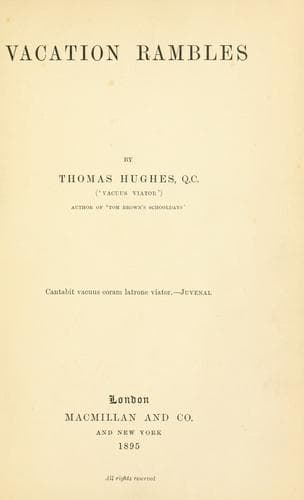
Europe -- Description and travel; United States -- Description and travel
As to more serious matters, you may be sure I lost no chance of talking
on our crisis with every intelligent American or Canadian,--and I
happened upon a great number of the latter. Amongst the majority of
Americans I was much struck, and, I own, surprised, to find a sort of
lazy fatalism prevailing, so far as they troubled their heads at all
about the Irish question. Not a man of them believed in the tyranny of
the British Government or the wrongs of the Irish; but they seemed to
think it was somehow destiny. They knew the Irish--were likely to have
at least as bad a time with them as we are having--but, unless you made
up your minds to shoot, there was no putting them down or bringing them
to reason. They had had to shoot--in New York during the war, and at
other times--and might probably have to shoot again \ but then, that
was over vital matters. We should never make up our minds to shoot over
letting them have a Parliament at Dublin, and so they would get it by
sheer insolence and intrigue. Such views would have depressed me had
I not found, on the other hand, that the few men who had mastered
the situation, without a single exception saw that it was a matter,
nationally, of life or death, and hoped our Government would shrink
from no measure necessary to restore the rule of law, and preserve the
national life.
Amongst the Canadians, on the other hand, I did not happen upon a single
Home-ruler--in fact, was obliged to own to myself that they seemed
to set more store by the unity of the Empire than we do in the
as-yet-United Kingdom. Indeed, if my acquaintances are at all
representative of the views of our Canadian fellow-subjects, I feel
very sure that the slight bond which holds the Dominion to us would
part within a few months of the triumph of the Home-rule agitation.
This possible fiasco, however, did not seem to them much worth thinking
about; but what was really exercising them was the probability of a
more intimate union or federation with the Mother-country. For defensive
purposes, I was glad to find that they saw no difficulty whatever;
believed, indeed, that that question was already solved. But all
felt that the really difficult problem was a commercial union, which,
nevertheless, must be managed somehow, if the Empire is to hold
together. On this there were wide differences of opinion, but, on the
whole, a decided inclination to a plan which I will endeavour to put in
a few words. It is, that every portion of the Empire shall be free, as
at present, to impose whatever tariff of customs it might think best
for raising its own revenue; but an agreed discount (say, ten per
cent) should be allowed on all goods the manufacture or product of the
Mother-country, or any of its possessions. Inasmuch, it was argued, as
such à plan would allow the free admission of all food and raw material,
it ought not to hurt the Free-trade susceptibilities of England, while
leaving the self-governing Colonies and India free to raise their own
Public-domain text, read in full here on John Shaqi.
Reviews
Reviews
No reviews yet
Be the first to share your thoughts on this work.
Elsewhere in the archive
Join the Discussion
Join the discussion
Sign in to leave a comment or review.
Sign InorCreate an account