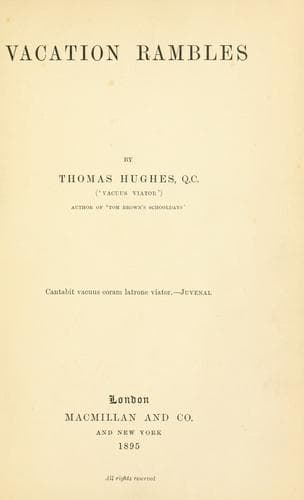
Europe -- Description and travel; United States -- Description and travel
If we turn from the volunteer to the regular side of Church work, Whitby
still has an almost unique attraction for the student of the religious
movement in England. The late Dean Stanley, who loved every phase of the
historical development of the life of the National Church, and mourned
over the thoroughness of recent restorations, which, as he thought,
threaten the entire disappearance of the surroundings and forms of the
worship of the Georgian era, would have thanked God and taken courage
if he could have visited Whitby Parish Church in 1888, for church and
service are a perfect survival. The wave of Victorian ecclesiastical
reform, without destroying anything, seems to have gently removed all
that was really objectionable, and breathed new life into the dry
bones of Georgian worship. I am not sure that I should say “everything
objectionable,” for probably the vast majority of even truly Catholic
church-goers would not agree as to the big shield with the national arms
which hangs over the centre of the chancel arch, dividing the two tables
of the Ten Commandments. I am prepared to admit that this particular
lion and unicorn are not good specimens of discreet beasts of their
respective kinds. But even as they stand they are national symbols, and
no reminder that Church and nation are still one can be spared nowadays;
and they are not half so grotesqile as most of the gurgoyles you will
see in the noblest Gothic cathedrals. And then they vividly remind my
generation of the days when they first toddled to church in the
family procession. The church itself is a gem, though with no orthodox
architectural beauty, for it retains traces of the handiwork of thirty
generations in its walls, pillars, galleries, and stunted square
tower,--from the round arches (there are still two, though the best, a
fine Norman window, has been bricked up) of its earliest builders in the
twelfth, to the white-washed walls and ceilings and square-paned windows
of eighteenth century churchwardens. I should think the three-decker (I
am obliged to use the profane name, having forgotten the correct one),
the clerk’s desk, reading-desk, and pulpit rising one above the other
in front of the chancel, must be unique, the last of its race. The clerk
has, indeed, retired into the choir; but the rector still reads the
prayers and lessons admirably from his desk, and ascends the pulpit,
where he is on a level with the faculty pew of the squire, and the low
galleries, to deliver his excellent short discourses. Long may he and
his successors do so. One is only inclined to regret that he does not
take off his surplice in the reading-desk, and ascend to preach in his
black gown. Curious it is to remember that less than thirty years ago
Bryan King and others excited riots in many parishes by preaching in
the surplice. The pews on the floor are all high oaken boxes with
doors, though the great majority of them are now free. The visitor in
Public-domain text, read in full here on John Shaqi.
Reviews
Reviews
No reviews yet
Be the first to share your thoughts on this work.
Elsewhere in the archive
Join the Discussion
Join the discussion
Sign in to leave a comment or review.
Sign InorCreate an account