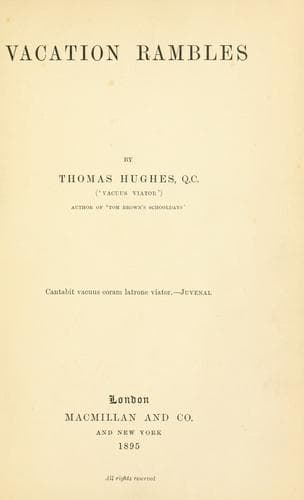
Europe -- Description and travel; United States -- Description and travel
And so we all went back to lunch, and Mullins
took his fee and departed. I know, sir, that you have many scientific
readers, and can picture to myself the smile tinged with scorn with
which they will turn to your next page when they get thus far. Well, I
own that the boring remains to be done, the results of which I hope to
send you in due course. Meantime, let me remind them of a well-known
adventure of one of the most famous of their predecessors towards the
end of last century. Sir Joseph Banks, botanising on the downs on a
cloudless June day, came across a shepherd whom he greeted with the
customary “Fine day,”--“Ees,” was the reply, “but there’ll be heavy rain
yet, afore night.” Sir Joseph passed on unheeding, and got a thorough
drenching before he reached his inn. Next morning he went back, found
the shepherd, and put a guinea in his hand, with “Now, my man, tell me
how you knew there was going to be rain yesterday afternoon.”
“Whoy,” said Hodge, with a grin, “I zeed my ould ram a shovin’ hisself
back’ards in under thuck girt thornin bush; and wenever a doos that
there’ll sartin sure be heavy rainfall afore sundown.”
Note.--Water was found where it was expected by the Diviner, and this
well is now used by the tenants of the Deer Leap Cottages.--October
1895.
Sequah’s “Flower of the Prairie,” Chester, 26th March 1890.
“Why, what on earth can this be?” I asked of the man who stood next me
in the Foregate some ten days ago, as we paused at a crossing to allow
the strange object which had drawn from me the above ejaculation to pass
on, with its attendant crowd. It was a mighty gilded waggon, certainly
fourteen feet long by six feet or seven feet broad. It was drawn by four
handsome bays. On two raised seats at the front sat eight men, English,
I fancy, every man of them, but clad over their ordinary garments in
long leather coats with fringes, such as our familiar Indians wear in
melodrama, and in the broad-brimmed, soft felts of the Western cowboy.
They were all armed with brass instruments and made the old streets
resound with popular airs. Behind these raised seats, in the body of
the waggon, rode some half dozen, including three strapping brown men,
Indians, I fancy they pose for, but they looked to me more like the
half-castes whom one sees on the Texan and Mexican ranches on the Bio
Grande. They also were clad in fringed leather coats, and wore sombreros
over their long black locks. The sides of the waggon, where not gilt,
were panelled with mirrors, on which were emblazoned the Stars and
Stripes and other coloured devices. Altogether, the thing seemed to me
well done in its way, whatever it might mean; and I turned inquiringly
to my neighbour and repeated my question, as the huge gilded van and
its jubilant followers passed away down the station road. “Oh! ’tis the
‘Merikin chap, as cures folks’s rheumatics and draws their teeth.”
Public-domain text, read in full here on John Shaqi.
Reviews
Reviews
No reviews yet
Be the first to share your thoughts on this work.
Elsewhere in the archive
Join the Discussion
Join the discussion
Sign in to leave a comment or review.
Sign InorCreate an account