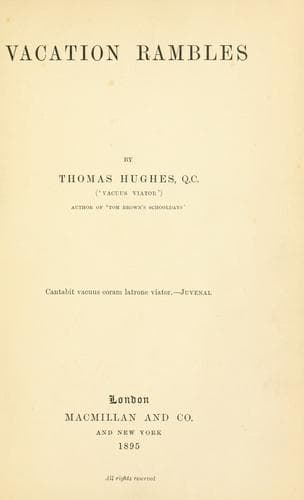
Europe -- Description and travel; United States -- Description and travel
There the controversy rests, I think; at any rate, so far as I heard it
debated; and I must own that the scientific explanation does not seem to
me to hold water. To take one instance, would the absorption of diseased
tissue drive a piece of cloth out of a soldier’s leg or body? Perhaps
yes, for what I know; but would the excitement of a mother cure the
disease of her child? These two classes of cures (of which there are a
great number) struck me, perhaps, more than any of the rest. But I must
not take up more of your space, and can only advise all your readers who
are really interested in this problem to take the first opportunity they
can of going to Lourdes, and, if possible, as we did, at a time when the
great bodies of pilgrims are not there, and they can quietly examine the
facts there, for--_pace_ the doctors and men of science--these tablets,
swords, crutches, etc., are facts which they are bound to acknowledge
and investigate. I shall be surprised if they do not come away, as I
did, with a feeling that they have seen a deeply interesting sight for
which it is well worth while to come from England, and that there are
two sides to this question of the Lourdes miracles (so-called), either
of which any reverent student of the world in which he is living may
conscientiously hold.
Fontarabia, 22nd April 1893.
Every year the truth of Burns’s “the best-laid schemes o’ mice and men
gang aft a-gley,” comes more home to me. From the time I was ten the
Pass of Roncesvalles has had a fascination for me. Then the habit of
ballad-singing was popular, and a relative of mine had a well-deserved
repute in that line. Amongst her old-world favourites were “Boland the
Brave” and “Durandarté.” The first told how Boland left his castle
on the Rhine, where he used to listen to the chanting in the opposite
convent, in which his lady-love had taken the veil on the false
report of his death, and “think she blessed him in her prayer when the
hallelujah rose”; and followed Charlemagne in his Spanish raid, till “he
fell and wished to fall” at Boncesvalles. The second, how Durandarté,
dying in the fatal pass, sent his last message to his mistress by his
cousin Montesinos. In those days I never could hear the last lines
without feeling gulpy in the throat:--
Kind in manners, fair in favour,
Mild in temper, fierce in fight,--
Warrior purer, gentler, braver,
Never shall behold the light.
They may not be good poetry, but Monk Lewis, the author, never wrote any
others as good. Then Lockhart’s _Spanish Ballads_ were given me, and in
one of the best of those stirring rhymes, Bernardo del Carpio’s bearding
of his King, I read--
The life of King Alphonso I saved at Roncesval,
Your word, Lord King, was recompense abundant for it all;
Your horse was down, your hope was flown; I saw the falchion
shine
Public-domain text, read in full here on John Shaqi.
Reviews
Reviews
No reviews yet
Be the first to share your thoughts on this work.
Elsewhere in the archive
Join the Discussion
Join the discussion
Sign in to leave a comment or review.
Sign InorCreate an account