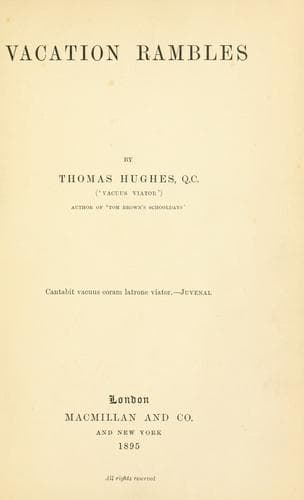
Europe -- Description and travel; United States -- Description and travel
reckless West End hansoms. Like one of your recent correspondents, I
could distinguish natives from visitors, as each of the latter had a
tight hold of the bar--a precaution which the native scorned. I managed
to extract from an enthusiastic admirer--a young Irish subaltern who
had ridden on them all his life--the confession that he had left a car
involuntarily (or, _Anglid_, had been shot out) three times in the last
eighteen months; but then, as he explained, he always fell on his feet!
I was touched again and again by the almost pathetic craving for
English appreciation,--quite as strong, I think, as, and certainly
much pleasanter than, that of our American cousins. I was exploring the
Killarney Lakes, in the first-rate four-oared boat of a cadet of the
MacGrillicuddy family, who, with his English wife, exercises a very
delightful hospitality almost under the shadow of “The Reeks,” which
bear his name. It was a perfect day, the changing lights and tints on
mountains and woods and lakes being more delicately lovely than any I
could recall, except, perhaps, at the head of the Lake of Geneva. We
had been talking of the Scotch lakes, and I could not help saying, “Why,
this beats Loch Katrine and Ellen’s Isle out of the field.”
“Ah,” said our host, with a sigh, “if only Sir Walter Scott had been an
Irishman!” and then he went on to speak of the neglect of Ireland by the
Royal Family and English governing people--e.g. Lord Beaconsfield had
never set foot in her, and Mr. Gladstone only once, for an hour or
two, to receive the freedom of Dublin. But why had the Queen made her
favourite home in Scotland, and left poor Ireland out in the cold?
Why did the English flock to Scotch rivers and moors and golf-links in
crowds every autumn when only a stray sportsman or tourist found his way
to Killarney or Connemara or Donegal? It was all owing to the Wizard of
the North, who had made Scotland enchanted ground.
Without ignoring other and deeper causes, I think one cannot but feel
what a difference it would have made if Sir Walter had been Irish. The
Siege of Derry is a more heroic and pathetic story than any in Scotch
annals of the struggle for the Stuarts, and the genius which has made
us intimate friends of the Baron of Bradwardine and Dugald Dalgetty, of
Dandie Dinmont, Edie Ochiltree, Jeanie Deans, Cuddie and Mause Headrigg,
and a dozen other Scotch men and women, would surely have found as good
materials for character-painting among the Irish peasantry. But the
speculation, though interesting, is too big to deal with at the end of a
paper.
“Poor Paddy-Land!”--II
Public-domain text, read in full here on John Shaqi.
Reviews
Reviews
No reviews yet
Be the first to share your thoughts on this work.
Elsewhere in the archive
Join the Discussion
Join the discussion
Sign in to leave a comment or review.
Sign InorCreate an account