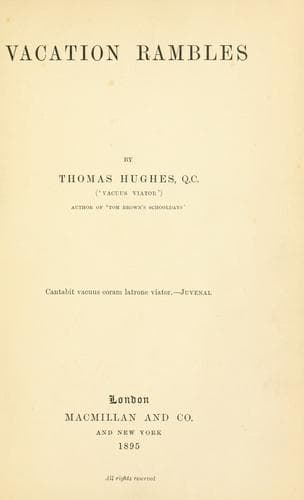
Europe -- Description and travel; United States -- Description and travel
Something must be done to counteract this, to put the case clearly
before our people. Mr. Mason and his friends were already establishing a
Confederate States Aid Association; it must be met by something similar
on the right side. So in 1862 the Emancipation and the Union and
Emancipation Societies were started in London and in Manchester, and in
good time came Mr. Lincoln’s proclamation of emancipation to strengthen
our hands. The original manifesto of the Emancipation Society said--“To
make it clear by the force of indisputable testimony that the South
is fighting for slavery, while the North is fully committed to the
destruction of slavery, is the principal object for which this society
is organised. Its promoters do not believe that English anti-slavery
sentiment is dead or enfeebled. They are confident that when the demands
and designs of the South are made clear, there will be no danger of
England being enticed into complicity with them.” We pledged ourselves
to test the opinion of the country everywhere by public meetings, and
challenged the Confederate States Aid Association to accept that test.
They did so; but I never could hear of any even quasi public meeting but
one which they held in England. That meeting was at Mr. Mason’s house,
and was, I believe, attended by some fifty persons.
The first step of our societies was to hold meetings for passing an
address of congratulation to your President on the publication of the
Emancipation proclamation. It was New Year’s Eve 1862. Our address said:
“We have watched with the warmest interest the steady advance of your
policy along the path of emancipation; and on this eve of the day on
which your proclamation takes effect we pray God to strengthen your
hands, to confirm your noble purpose, and to hasten the restoration of
that lawful authority which engages, in peace or war, by compensation
or by force of arms, to realise the glorious principle on which your
constitution is founded--the brotherhood, freedom, and equality of
all men.” The address was enthusiastically adopted by a large meeting,
chiefly composed of working men. It was clear at once that there was
a grand force behind us, for we became objects of furious attack. The
_Times_ called us impostors, and said we got our funds for the
agitation from American sources--the fact being that we always refused
contributions from this side. The _Saturday Review_ declared, in one
of its bitterest articles, that if anything could be calculated upon as
likely to defer indefinitely the gradual extinction of slavery, it
would be Mr. Lincoln’s fictitious abolition of it. We were meddlesome
fanatics, insignificant nobodies, mischievous agitators. This was
satisfactory and encouraging. We felt sure that we had taken the
right course, and not a moment too soon. Then came the test of public
meetings, which you at least are surely bound to accept as a fair gauge
of what a people thinks and wills.
Public-domain text, read in full here on John Shaqi.
Reviews
Reviews
No reviews yet
Be the first to share your thoughts on this work.
Elsewhere in the archive
Join the Discussion
Join the discussion
Sign in to leave a comment or review.
Sign InorCreate an account