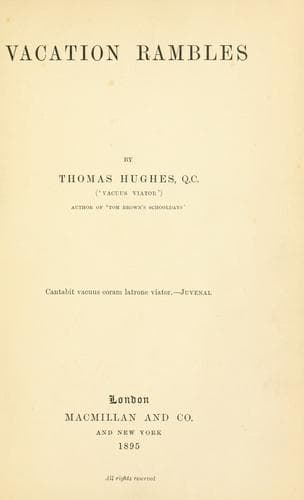
Europe -- Description and travel; United States -- Description and travel
Then came the first public effort of the sympathisers with the
rebellion. After several preliminary skirmishes, which were defeated
by Mr. Forster (who had what we lawyers should call the watching brief,
with Cobden and Bright behind him as leading counsel, and who used to
go round the lobbies in those anxious days with his pockets bulging out
with documents to prove how effective the blockade was, and how many
ships of our merchants you were capturing every day), Mr. Gregory put a
motion on the paper. He was well chosen for the purpose, as a member of
great experience and ability, sitting on our side of the House, so that
weak-kneed Liberals would have an excuse for following him, and though
not himself in office, supposed to be on intimate terms with the Premier
and other members of the Cabinet. His motion was simply “to call the
attention of the House to the expediency of prompt recognition of the
Southern Confederacy.”
It was set down for 7th June 1861, and I tell you we were all pretty
nervous about the result. The _Spectator, Daily News, Star_, and other
staunch papers opened fire, and we all did what we could in the way of
canvassing; but until the Government had declared itself no Union man
could feel safe. Well, Lord John Russell, as the Foreign Minister,
got up, snubbed the motion altogether, said that the Government had no
intention whatever of agreeing to it, and recommended its withdrawal.
So Mr. Gregory and his friends took their motion off the paper without a
debate, and did not venture to try any other during the session of 1861.
In the late autumn came the unlucky _Trent_ affair, to which I have
already sufficiently alluded. Belying on the feeling which had been
roused by it, and cheered on by the Mason club in Piccadilly and the
_Index_ newspaper fulminations, and by the severe checks of the Union
armies, they took the field again in 1862. This time their tactics were
bolder. They no longer confined themselves to asking the opinion of the
House deferentially. Mr. Lindsay, the great shipowner, who it was said
had a small fleet of blockade-runners, was chosen as the spokesman. He
gave notice of motion, “That in the opinion of this House, the States
which have seceded from the Union have so long maintained themselves,
and given such proofs of determination and ability to support
independence, that the propriety of offering mediation with a view to
terminating hostilities is worthy of the serious and immediate attention
of Her Majesty’s Government.” Again we trembled for the result, and
again the Government came out with a square refusal on the 18th of July,
and this motion shared the fate of its predecessor, and was withdrawn by
its own promoters.
Public-domain text, read in full here on John Shaqi.
Reviews
Reviews
No reviews yet
Be the first to share your thoughts on this work.
Elsewhere in the archive
Join the Discussion
Join the discussion
Sign in to leave a comment or review.
Sign InorCreate an account