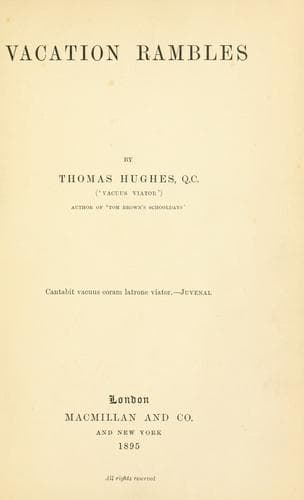
Europe -- Description and travel; United States -- Description and travel
Such is our case as to the cruisers which did you so much damage. I
believe it to be true. If we are mistaken, however, you will get such
damages for each and all of these vessels as the arbitrator may award.
We reserve nothing. I as an Englishman am deeply grieved that any of my
countrymen, for base love of gain or any other motive, should have dared
to defy the proclamation of my Sovereign, speaking in the nation’s name.
I earnestly long for the time when by wise consultation between our
nations, and the modification of the public law bearing on such cases,
not only such acts as these, but all war at sea, shall be rendered
impossible. The United States and England have only to agree in this
matter, and there is an end of naval war through the whole world.
In 1863 the horizon was still dark. Splendid as your efforts had been,
and magnificent as was the attitude of your nation, tried in the fire
as few nations have been in all history, those efforts had not yet been
crowned with any marked success. With us it was the darkest in the whole
long agony, for in it came the crisis of that attempt of the Emperor of
the French to inveigle us in a joint recognition of the Confederacy,
on the success of which his Mexican adventure was supposed to hang. The
details of those negotiations have never been made public. All we
know is, that Mr. Lindsay and Mr. Roebuck went to Paris and had long
conferences with Napoleon, the result of which was the effort of Mr.
Roebuck (now in turn the representative of the rebels in our Parliament)
to force or persuade our Government into this alliance. Then came the
final crisis. On the 30th of June 1863, a day memorable in our history
as in yours, at the very time that your army of the Potomac was hurrying
through the streets of Gettysburg to meet the swoop of those terrible
Southern legions, John Bright stood on the floor of our House of
Commons, on fire with that righteous wrath which has so often lifted him
above the heads of other English orators.
He dragged the whole plot to light, quoted the former attacks of Mr.
Roebuck on his Imperial host, and then turning to the Speaker, went on,
“And now, sir, the honourable and learned gentleman has been to Paris,
introduced there by the honourable member for Sunderland, and he has
sought to become, as it were, a co-conspirator with the French Emperor,
to drag this country into a policy which I maintain is as hostile to its
interests as it would be degrading to its honour.” From that moment the
cause of the rebellion was lost in England; for by the next mails came
the news of the three days’ fight, and the melting away of Longstreet’s
corps in the final and desperate efforts to break the Federal line on
the slopes of little Round Top. A few weeks more and we heard of the
surrender of Vicksburg, and no more was heard in our Parliament of
recognition or mediation.
Public-domain text, read in full here on John Shaqi.
Reviews
Reviews
No reviews yet
Be the first to share your thoughts on this work.
Elsewhere in the archive
Join the Discussion
Join the discussion
Sign in to leave a comment or review.
Sign InorCreate an account