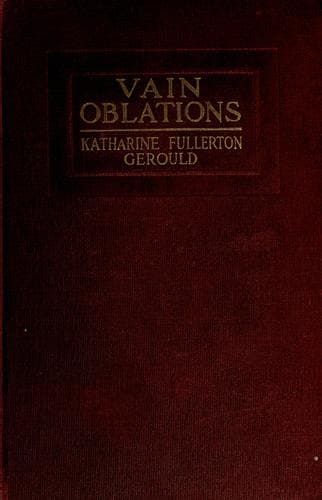
American fiction -- 20th century; Short stories, American
Hoyting stopped. The lights winked out along the boulevard. Night had
fallen with capricious suddenness. I ordered more drinks quietly.
Hoyting was breathing hard; tired out, and, as I thought, very weary of
it all, longing to slip the leash and be off. The air was cool and soft,
and the crowd was thinning a little. People were dining and making ready
to “go on.” I couldn’t have stirred, but that worn packet suddenly felt
very heavy in my pocket.
Hoyting began sipping vermouth again. Finally he spoke. “He didn’t say a
great deal more. The end was too near. But he spoke very clearly when he
did speak; and whenever his eyes were open, they were fixed on Madame
Pothier. Towards the last he put out his hand to me. I was holding the
note-books--I shouldn’t have dared put them down so long as he was
conscious. ‘There is only one woman in the world,’ he said, ‘and she
belongs to Pothier. Look at her.’ I didn’t look at her, and he went on:
‘There may be other women alive, but I can’t believe it. Do you believe
it?’
“He wasn’t wandering, you know. His mind had merely stripped his
situation to its essentials; he was quite alone with the only facts that
counted. He had summed life up, and didn’t have to keep truce any longer
with mortal perspectives. He drew the real things round him like a
cloak.... Absurd to talk of inconsequence; there was no inconsequence.
“I bent over him. ‘I’m not blind, Paramore.’
“‘No, but I am--blessedly blind.... And some day she’ll hate me, you
think?’
“His lips were straining to ask me to see to it that she didn’t, but he
controlled them. That--as much as anything--is why I’m here with you
now. It was more than decent of him; it was fine. But, by the same token
that he couldn’t ask, I couldn’t promise--though I saw that another
_crise_ was near and the doctor was crossing over to the bed.
“‘I don’t believe she ever will,’ I said. ‘There’s so much she’ll never
know.’
“I was thinking of his forlorn and beautiful passion for her, which she
would have hated him for, because she would always have been afraid it
was somehow her fault. Not quite fair when you work it out, but those
women are like that. I saw in a flash, though--he took his eyes off her
and looked at me, just once--that he thought I meant his miserable,
discredited past. Then the doctor thrust me aside. The matter was never
explained between us.
“There were only one or two more speeches of Paramore’s to record. The
monosyllables wrung out of his weakness didn’t count--except, immensely,
for pity. Very likely you know what the fatal fever symptoms are--ugly
beyond compare. I won’t go into that. We were all pretty nearly done by
the time the blessed coma settled over him. He opened his eyes just once
more and fixed them on Madame Pothier, who stood at the foot of the bed.
All his strength was in his poor eyes: his body was a corpse already. It
was to me he spoke, but he looked at her until the lids fell. ‘Damn
Whitaker! He’s a worm; but not such a worm as I.’
Public-domain text, read in full here on John Shaqi.
Reviews
Reviews
No reviews yet
Be the first to share your thoughts on this work.
Elsewhere in the archive
Join the Discussion
Join the discussion
Sign in to leave a comment or review.
Sign InorCreate an account