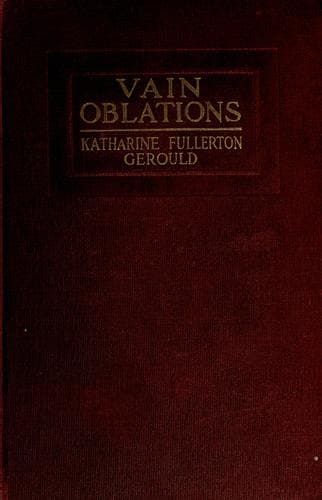
American fiction -- 20th century; Short stories, American
“I don’t suppose you can understand it--any of it--for the simple reason
that I can’t describe her. She was the kind of person who sees very
clearly the difference between the possible and the impossible; who
never attempts anything but the possible; yet who sets every one about
her itching to attain the impossible. Not ‘for her sake,’ in the
conventional sense; no, not that at all. Simply, she set before you so
clearly the reason why a thing couldn’t be done that you longed to
confute her, just as you sometimes long to confute fate. She was as
convincing and as maddening as a natural law. Each of us, sooner or
later, has tried to get the better of some little habit of the universe.
You felt like saying: ‘Stop looking like that; I’ll do it--see if I
don’t.’
“That was the spirit in which I went to her, late one afternoon, on her
parapet. The C.’s had been away all day and were not to return until
evening. Madame C. had exasperated me the night before by proposing,
quite baldly and kindly, that the girl be decoyed into a sanatorium. The
C.’s couldn’t keep her much longer--they were off for Biskra--and it was
up to me. I had lain awake half the night, exploring the last recesses
of disaster into which my idea might lead me; I had sailed far out on
the bright waters all day, perfecting my courage. I could have written
as bitter a little allegory about it all as Heine himself. Secretly, in
a tawdry corner of my mind, I thought Wilhelm Meister was a poor stick
compared with me. But it was honest romance; I was willing to pay.”
I finished my whiskey as Chalmers’s voice dropped and died down, and he
busied himself a little nervously with lighting a pipe. His green eyes
had flecks of brown in them. Once more, in the speckled brown figure
opposite me, I saw the tortoise beyond the reach of biology, which
upholds the world, which carries the burden of all human flesh and
spirit.
“I told her that I was ready to go; that I could scrape together enough
money for the expedition without entirely impoverishing myself. My
figures hadn’t been quite so reassuring as that when I totted them up on
a piece of hotel paper at dawn, but at least I had left magnificent
margins for everything.
“She smiled--I had never seen her smile before, and at the moment it
made her thanks seem profuse--but she shook her head. She was
beautifully simple about it. I liked her for that.
“‘It wouldn’t do. Not that it isn’t divinely good of you! But, you see,
the point is that--’ she stopped.
“‘Well?’ My heart was beating hard. I had become enamored of my idea. I
no more wanted to be baulked than she did.
“‘The point has always been that I should go myself.’
“‘Then go yourself!’
“‘Carrying off all your money? I can’t--Don Quixote.’ There was nothing
playful in her tone; and she had me all the more because there wasn’t.
She was merely registering facts. Even the ‘Don Quixote’ was, to her
mind, a fact that she was registering. She was splendidly literal.
Public-domain text, read in full here on John Shaqi.
Reviews
Reviews
No reviews yet
Be the first to share your thoughts on this work.
Join the Discussion
Join the discussion
Sign in to leave a comment or review.
Sign InorCreate an account