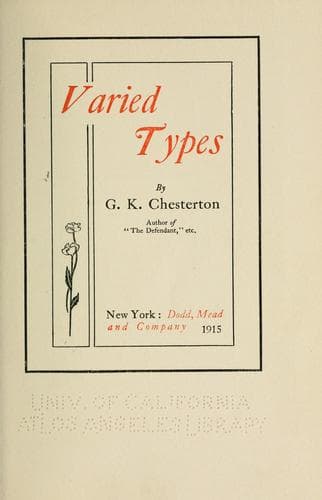
Biography; Essays; Literature, Modern -- 19th century -- History and criticism
Some of the costumes I have suggested might appear a little more
difficult to carry out. The dress of a person who purchases newspapers
(though it mostly consists of coloured evening editions arranged in a
stiff skirt, like that of a saltatrice, round the waist of the wearer)
has many mysterious points. The attire of a person prepared to criticise
the Poet Laureate is something so awful and striking that I dare not
even begin to describe it; the one fact which I am willing to reveal,
and to state seriously and responsibly, is that it buttons up behind.
But most assuredly we ought not to abuse the Kaiser because he is fond
of putting on all his uniforms; he does so because he has a large number
of established and involuntary incarnations. He tries to do his duty in
that state of life to which it shall please God to call him; and it so
happens that he has been called to as many different estates as there
are regiments in the German Army. He is a huntsman and proud of being a
huntsman, an engineer and proud of being an engineer, an infantry
soldier and proud of being so, a light horseman and proud of being so.
There is nothing wrong in all this; the only wrong thing is that it
should be confined to the merely destructive arts of war. The sight of
the German Kaiser in the most magnificent of the uniforms in which he
had led armies to victory is not in itself so splendid or delightful as
that of many other sights which might come before us without a whisper
of the alarms of war. It is not so splendid or delightful as the sight
of an ordinary householder showing himself in that magnificent uniform
of purple and silver which should signalise the father of three
children. It is not so splendid or delightful as the appearance of a
young clerk in an insurance office decorated with those three long
crimson plumes which are the well-known insignia of a gentleman who is
just engaged to be married. Nor can it compare with the look of a man
wearing the magnificent green and silver armour by which we know one who
has induced an acquaintance to give up getting drunk, or the blue and
gold which is only accorded to persons who have prevented fights in the
street. We belong to quite as many regiments as the German Kaiser. Our
regiments are regiments that are embattled everywhere; they fight an
unending fight against all that is hopeless and rapacious and of evil
report. The only difference is that we have the regiments, but not the
uniforms.
Public-domain text, read in full here on John Shaqi.
Reviews
Reviews
No reviews yet
Be the first to share your thoughts on this work.
Elsewhere in the archive
Join the Discussion
Join the discussion
Sign in to leave a comment or review.
Sign InorCreate an account