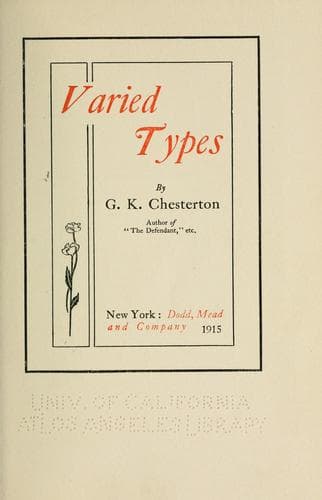
Biography; Essays; Literature, Modern -- 19th century -- History and criticism
Only one obvious point occurs to me to add. If the Kaiser has more than
any other man the sense of the poetry of the ancient things, the sword,
the crown, the ship, the nation, he has the sense of the poetry of
modern things also. He has one sense, and it is even a joke against
him. He feels the poetry of one thing that is more poetic than sword or
crown or ship or nation, the poetry of the telegram. No one ever sent a
telegram who did not feel like a god. He is a god, for he is a minor
poet; a minor poet, but a poet still.
TENNYSON
Mr. Morton Luce has written a short study of Tennyson which has
considerable cultivation and suggestiveness, which will be sufficient to
serve as a notebook for Tennyson's admirers, but scarcely sufficient,
perhaps, to serve as a pamphlet against his opponents. If a critic has,
as he ought to have, any of the functions anciently attributed to a
prophet, it ought not to be difficult for him to prophesy that Tennyson
will pass through a period of facile condemnation and neglect before we
arrive at the true appreciation of his work. The same thing has happened
to the most vigorous of essayists, Macaulay, and the most vigorous of
romancers, Dickens, because we live in a time when mere vigour is
considered a vulgar thing. The same idle and frigid reaction will almost
certainly discredit the stateliness and care of Tennyson, as it has
discredited the recklessness and inventiveness of Dickens. It is only
necessary to remember that no action can be discredited by a reaction.
The attempts which have been made to discredit the poetical position of
Tennyson are in the main dictated by an entire misunderstanding of the
nature of poetry. When critics like Matthew Arnold, for example, suggest
that his poetry is deficient in elaborate thought, they only prove, as
Matthew Arnold proved, that they themselves could never be great poets.
It is no valid accusation against a poet that the sentiment he expresses
is commonplace. Poetry is always commonplace; it is vulgar in the
noblest sense of that noble word. Unless a man can make the same kind of
ringing appeal to absolute and admitted sentiments that is made by a
popular orator, he has lost touch with emotional literature. Unless he
is to some extent a demagogue, he cannot be a poet. A man who expresses
in poetry new and strange and undiscovered emotions is not a poet; he is
a brain specialist. Tennyson can never be discredited before any serious
tribunal of criticism because the sentiments and thoughts to which he
dedicates himself are those sentiments and thoughts which occur to
anyone. These are the peculiar province of poetry; poetry, like
religion, is always a democratic thing, even if it pretends the
contrary. The faults of Tennyson, so far as they existed, were not half
so much in the common character of his sentiments as in the arrogant
perfection of his workmanship. He was not by any means so wrong in his
faults as he was in his perfections.
Public-domain text, read in full here on John Shaqi.
Reviews
Reviews
No reviews yet
Be the first to share your thoughts on this work.
Elsewhere in the archive
Join the Discussion
Join the discussion
Sign in to leave a comment or review.
Sign InorCreate an account