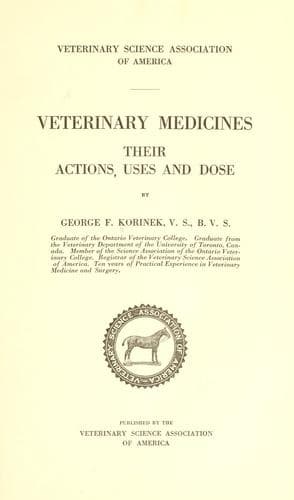
Veterinary Medicines, Their Actions, Uses and DoseKorinek, George Franklyn
Science
Veterinary Medicines, Their Actions, Uses and Dose
Korinek, George Franklyn
Veterinary drugs
PROPERTIES.--White or nearly translucent, orthorhombic prisms,
octahedral crystals, or a crystalline powder; odorless and having a
faintly bitter taste; slightly efflorescent in warm air. Soluble in
water, alcohol, ether and chloroform.
DOSE.--Dogs, ¹⁄₄ to 1¹⁄₂ gr.
HEROIN--DIACETYLMORPHINE
This drug is a derivative of morphine, and is now used extensively in
human medicine as a substitute for morphine and codeine.
PROPERTIES.--White or colorless, crystalline powder, possessing a
slightly bitter taste. Insoluble in water, but readily soluble in weak
acidous solutions. Heroin hydrochloride is a white, crystalline powder,
odorless, soluble in 2 parts of water. Heroin surpasses both morphine
and codeine therapeutically in many ways. It increases markedly the
inspiratory and expiratory force, while lessening the number of the
respiratory movements and exerts a special sedative influence on the
respiratory mucous membranes. The drug acts also as a general motor
depressant, hypnotic and analgesic, but is not comparable to morphine in
these respects. Heroin is about five times more toxic for dogs than
morphine. Heroin is particularly valuable in the treatment of all
varieties of coughs affecting the dog. The after-effects of small doses
are not as nauseating or constipating as morphine.
Heroin can be given in powder, pill or tablet, the Heroin hydrochloride
in solution, every three or four hours.
DOSE OF EITHER.--Horses, ¹⁄₂ to 2 gr.; dogs, ¹⁄₂₄ to ¹⁄₆ gr.
ACTIONS.--Opium is analgesic, hypnotic, diaphoretic, antispasmodic,
narcotic; also cardiac and respiratory depressant after primary brief
stimulation.
MEDICAL DOSES.--It dries all secretions except the mammae and skin. The
latter being increased, it produces dryness of the mouth and throat,
arrests gastric secretions, retards digestion and causes anorexia (loss
of appetite); it stimulates the brain by increasing the blood supply; in
man it stimulates the mental activity, while in animals it stimulates
motor activity; it does not affect the conductivity of nerves, but it
prevents the consciousness to pain by paralyzing the nerve centers; the
action of the heart is increased and arterial tension is raised; the
pupil slightly contracted; the mind at first stimulated, becomes calm,
sleep follows, disturbed by dreams and headache; constipation and some
depression follows.
LARGE DOSES.--Arrest digestion, cause nausea and vomiting, greatly
increase perspiration, prevents the conductivity of nerves, depresses
the heart and circulation, impairing oxidation and lowering temperature;
it contracts the pupil by stimulating the motor nerve of the eye (in
horses it dilates the pupil) and causes intense puritis (itching),
especially of the nose, often retention of the urine and soon profound
sleep; in some cases coma or delirium, leaving as after-effects nausea,
depression, constipation, vertigo, anorexia, nasal puritis and fetid
pathological secretions.
Public-domain text, read in full here on John Shaqi.
Reviews
Reviews
No reviews yet
Be the first to share your thoughts on this work.
Elsewhere in the archive
Join the Discussion
Join the discussion
Sign in to leave a comment or review.
Sign InorCreate an account