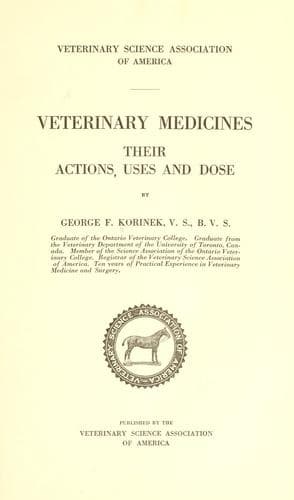
Veterinary Medicines, Their Actions, Uses and DoseKorinek, George Franklyn
Science
Veterinary Medicines, Their Actions, Uses and Dose
Korinek, George Franklyn
Veterinary drugs
USES.--Potassium iodide is useful in promoting absorption of enlarged
lymphatic glands, and its action should be assisted by the application
of iodine or red iodide of mercury externally. Potassium iodide in small
doses diminishes congestion and increases the fluidity and amount of
secretions in acute laryngitis, acute and subacute bronchitis, and
appears to possess an alterative action in improving the condition and
nutrition of the bronchial mucous membranes. It is also of some value in
asthma, pulmonary emphysema and chronic bronchitis, unassociated with
copious secretion. Chronic pleuritis, pericarditis and ascites are
treated with potassium iodide, which assists absorption and occasionally
exerts a diuretic effect. Tardy resolution of pneumonia consolidation is
hastened by potassium iodide. Endocarditis with cardiac hypertrophy is
said to be benefited by potassium iodide and digitalis.
Champignon, or scirrhous cord in horses, is sometimes cured by the
sorbefacient powers of potassium iodide in full doses. Potassium iodide
is of value in goiter of dogs, calves and sheep when tincture of iodine
is used externally. “Roaring” and “thick wind” may be cured by the
administration of potassium iodide. It is the best medicine known for
actinomycosis. Potassium iodide has a clinical reputation for its power
to aid absorption and resolution in inflammation or effusions of the
brain or spinal cord, in paralysis of the body or limbs and inflammation
of the membranes covering the brain.
DOSES.--Horses, 2 to 4 dr.; cattle, 3 to 6 dr.; sheep and pigs, 15 to 30
gr.; dogs, 1 to 10 gr.
It should be given to the larger animals in doses of three drachms
daily, until iodism appears, which shows itself by loss of appetite, an
irritable, catarrhal condition of the mucous membranes of the nostrils,
eyes, throat and digestive organs, a vesicular skin eruption, abstinence
from water, diminished secretions of urine, temperature elevated and
emaciation.
POTASSII NITRAS--POTASSIUM NITRATE--NITRATE OF POTASH--NITER--SALTPETRE
DERIVATION.--Nitrate of potash may be obtained by purifying crude niter,
or by the interaction of sodium nitrate and potassium chloride.
PROPERTIES.--Colorless, transparent, six-sided, rhombic prisms, or a
crystalline powder, odorless and having a cooling, saline and pungent
taste. Permanent in the air. Soluble in water; very sparingly soluble in
alcohol.
DOSE.--Horses and cattle, 1 to 2 oz.; sheep and pigs, 2 to 6 dr.; dogs,
5 to 20 gr.
ACTIONS.--Large doses irritate the stomach, bowels and kidneys; medical
doses are alterative, febrifuge, diuretic and feebly laxative. Excreted
by the bronchial glands, skin and kidneys, increasing secretions of
these organs; is a cardiac depressant and mild refrigerant and
diaphoretic.
Nitrate of potash is more frequently prescribed than any other potash
salt in veterinary medicine, and is commonly considered one of the best
febrifuges. Its only service in fevers is as a diuretic.
Public-domain text, read in full here on John Shaqi.
Reviews
Reviews
No reviews yet
Be the first to share your thoughts on this work.
Elsewhere in the archive
Join the Discussion
Join the discussion
Sign in to leave a comment or review.
Sign InorCreate an account