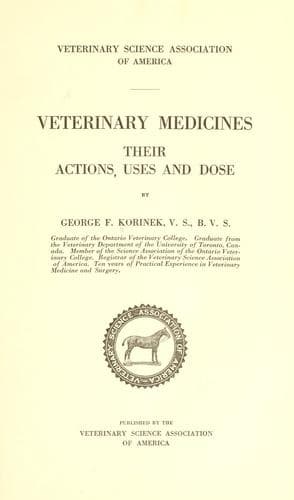
Veterinary Medicines, Their Actions, Uses and DoseKorinek, George Franklyn
Science
Veterinary Medicines, Their Actions, Uses and Dose
Korinek, George Franklyn
Veterinary drugs
PROPERTIES.--A colorless or pale yellow, and strongly refractive liquid,
having a very pungent and acrid odor and taste. Freely soluble in
alcohol, ether or carbon disulphide, the solution being neutral to
litmus paper. Specific gravity 1.013 to 1.020.
ACTIONS.--Is irritant or counter-irritant, rubefacient, vesicant or
suppurant, according to the manner in which it is used; it acts much
quicker than cantharides, but its action is not so prolonged; the paste
made with water and rubbed into the skin of horses, produces its effects
within twenty minutes; in two to six hours vesication occurs, pustules
may occur where the paste is used very strong or closely repeated, or
too much has been used.
The volatile oil of mustard is a very powerful vesicant and acts very
quickly.
USES.--It is used as a counter-irritant in laryngitis, pharyngitis,
bronchitis, pneumonia and pleurisy, or wherever a counter-irritant is
indicated; applied in the early congested stages it lessens the pain and
relieves difficult breathing, besides reflexly limiting the amount of
blood in the parts; it thus limits or decreases the inflammatory action;
also useful in the exudative stages of these diseases; to promote the
absorption of the exudate and thus hasten resolution, or where these
diseases remain dormant; also arouse a depressed nervous system and
reflexly stimulates the heart; can be used in spinal diseases or in
congestion of the kidneys.
It acts best when applied and left on 20 or 30 minutes, then washed off
and repeat in an hour or two; also used in acute indigestion, applied to
the abdomen; also in colic, enteritis and peritonitis; in phlebitis
mustard can be used, but a cantharides blister is better. In making a
mustard plaster, take the pure powdered mustard and gradually pour in
warm water (not hot); can also be made with cold water or vinegar; rub
in with moderate friction.
As an emetic for dogs one to two teaspoonfuls in one or two ounces of
warm water is very effective.
SODIUM BICARBONATE--BICARBONATE OF SODA
ORIGIN.--Bicarbonate of soda may be obtained by exposing crystals of
sodium carbonate to carbonic anhydride, or by the interaction of sodium
chloride and ammonium bicarbonate.
PROPERTIES.--Bicarbonate of soda is a white, opaque powder, odorless and
having a cooling, mildly alkaline taste. It is permanent in dry, but
slowly decomposes in moist air. Soluble in twelve parts of water at 15°
C. (59° F.); above this temperature the solution gradually loses carbon
dioxide, and at boiling heat the salt is entirely converted into normal
carbonate, insoluble in alcohol.
ACTIONS.--Antacid, peristaltic stimulant, carminative, alterative and
mildly anodyne externally. It also increases fluidity of and secretion
of gastric juice.
Public-domain text, read in full here on John Shaqi.
Reviews
Reviews
No reviews yet
Be the first to share your thoughts on this work.
Elsewhere in the archive
Join the Discussion
Join the discussion
Sign in to leave a comment or review.
Sign InorCreate an account