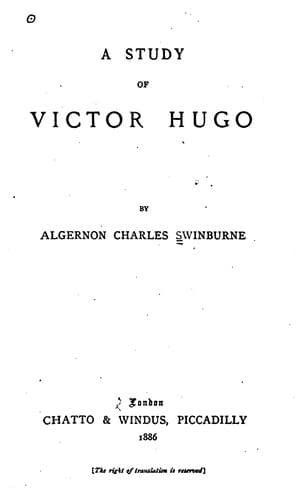
Hugo, Victor, 1802-1885 -- Criticism and interpretation
the golden ball of metre, carve arabesques of the same pattern, play
variations in the same key. But the _Old Man's Idyl_ which closes the
book belongs by kinship to another work of the poet's, more beloved and
more precious to the inmost heart, if not more eminent for strength and
cunning of hand, than any of these. In "the voice of a child a year old"
there is the same welling and bubbling melody which flows and laughs and
murmurs and glitters through the adorable verses of _L'Art d'être
Grand-père_, making dim with love and delight the reader's or the
hearer's eyes. At last the language of babies has found its interpreter;
and that, as might have been expected, in the greatest poet of his age.
L'enfant apporte un peu de ce ciel dont il sort;
Il ignore, il arrive; homme, tu le recueilles.
_Il a le tremblement des herbes et des feuilles._
La jaserie avant le langage est la fleur
Qui précède le fruit, moins beau qu'elle, et meilleur,
Si c'est être meilleur qu'être plus nécessaire.
A conclusion which may be doubted when we consider as follows:
L'enfant fait la demande et l'ange la réponse;
Le babil puéril dans le ciel bleu s'enfonce,
Puis s'en revient, avec les hésitations
Du moineau qui verrait planer les alcyons.
Can language or can thought be lovelier? if so, the one possible
instance is to be sought in these succeeding verses:
Quand l'enfant jase avec l'ombre qui le bénit,
La fauvette, attentive, au rebord de son nid
Se dresse, et ses petits passent, pensifs et frêles,
Leurs têtes à travers les plumes de ses ailes;
La mère semble dire à sa couvée: Entends,
Et tâche de parler aussi bien.
It seems and is not strange that the lips which distill such honey as
this should be the same so often touched with a coal of fire from that
"altar of Righteousness" where Æschylus was wont to worship. The
twenty-first section of the second series is in the main a renewal or
completion of the work undertaken in the immortal _Châtiments._ Even in
that awful and incomparable book of judgment such poems as _La Colère
du Bronze_, and the two following on the traffic of servile clerical
rapacity in matters of death and burial, would have stood high among the
stately legions of satire which fill its living pages with the sound and
the splendor of righteous battle for the right; but the verses with
which Hugo has branded the betrayer of Metz and Strasburg are hardly to
be matched except by those with which, half a century ago, he branded
the betrayer of the Duchess of Berry. Truly may all who read them cry
out with the poet at their close,
Et qui donc maintenant dit qu'il s'est évadé?
Public-domain text, read in full here on John Shaqi.
Reviews
Reviews
No reviews yet
Be the first to share your thoughts on this work.
Join the Discussion
Join the discussion
Sign in to leave a comment or review.
Sign InorCreate an account