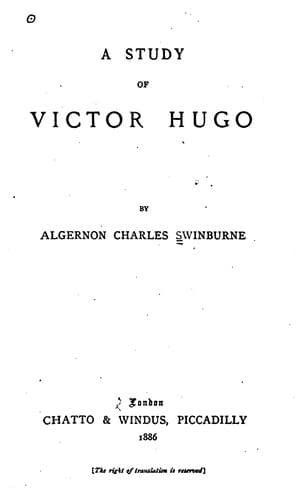
Hugo, Victor, 1802-1885 -- Criticism and interpretation
But of all echoes and of all responses which reverberate from end to end
of these three great sections of song, the very sweetest, and perhaps
the very deepest, are those evoked by love of little children, and
compassionate reverence for the poor. If but one division were to be
left us out of all the second series, and fate or chance, comparatively
compassionate in its cruelty, gave us our choice which this one should
be, the best judgments might perhaps decide to preserve the twenty-third
at all events. What the words "realism" and "naturalism" do naturally
and really signify in matters of art, the blatant babblers who use them
to signify the photography of all things abject might learn, if shallow
insolence and unclean egotism were suddenly made capable of learning, by
the study of only the two poems which set before us in two different
forms the strength of weakness in the child whose love redeems his
father from death, and the child who can find no comfort but in death
for the lack of a father's love. There is nothing in Homer, in Dante, or
in Shakespeare, the three only poets who can properly be cited for
comparison, of a pathos more poignant in its bitter perfection of
sweetness.
Among the many good things which seem, for the lovers of poetry, to have
come out of one and so great an evil as the long exile of Hugo from his
country, there is none better or greater than the spiritual inhalation
of breeze and brine into the very heart of his genius, the miraculous
impregnation of his solitary Muse by the sea-wind. This influence could
not naturally but combine with the lifelong influence of all noble
sympathies to attract his admiration and his pity towards the poor folk
of the shore, and to produce from that sense of compassion for obscurer
sorrows and brotherhood with humbler heroism than his own such work as
the poem which describes the charity of a fisherman's wife towards the
children of her dead neighbor. It has all the beautiful precision and
accurate propriety of detail which distinguish the finest idyls of
Theocritus or Tennyson, with a fervor of pathetic and imaginative
emotion which Theocritus never attained, and which Tennyson has attained
but once. All the horror of death, all the trouble and mystery of
darkness, seem as we read to pass into our fancy with the breath of
pervading night, and to vanish with the husband's entrance at sunrise
before the smile with which the wife draws back the curtains of the
cradle.
Public-domain text, read in full here on John Shaqi.
Reviews
Reviews
No reviews yet
Be the first to share your thoughts on this work.
Elsewhere in the archive
Join the Discussion
Join the discussion
Sign in to leave a comment or review.
Sign InorCreate an account