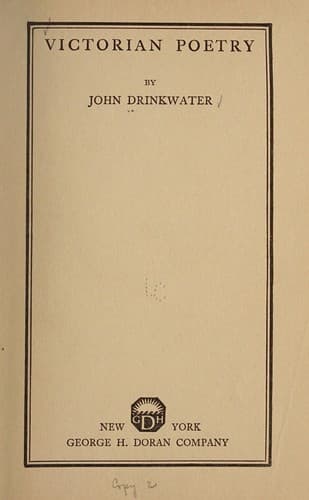
English poetry -- 19th century -- History and criticism; Great Britain -- History -- Victoria, 1837-1901
spiritual responsibility that can be found in Wordsworth, the one now
transfigured by passion and the other lit by a new imaginative variety.
With so much definition, therefore, the terms subjective and objective
may be used for our present purposes.
Scott’s poems are the best examples in English of poetry that is
purely, or almost purely, objective. And the neglect of more recent
criticism has, I suspect, left them still in the possession of the
affections of many readers. They are not only the best of their kind,
they could not very well be better. The finer narrative art of Chaucer,
suffused as it was by a much more personal contact with its content
matter, stands really in æsthetic significance, apart from the question
of individual genius, with the art that produced _King Lear_. In
the Victorian age the art of Scott found its inheritors, and, although
the schoolmasters have done their best to kill _The Lays of Ancient
Rome_, Macaulay was no bad practitioner in a kind of which we are
foolish to speak slightingly because it does not happen to be the
highest. If we can forget the class-room and put prejudice aside, and
keep our sense of values clear, there is something amiss with us if we
do not thrill to passages, of which there are many in the _Lays_,
such as
Then out spake brave Horatius,
The Captain of the Gate:
“To every man upon this earth
Death cometh soon or late.
And how can man die better
Than facing fearful odds,
For the ashes of his fathers,
And the temples of his Gods, ...”
and
Alone stood brave Horatius,
But constant still in mind;
Thrice thirty thousand foes before,
And the broad flood behind.
“Down with him!” cried false Sextus,
With a smile on his pale face,
“Now yield thee,” cried Lars Porsena,
“Now yield thee to our grace.”
Round turned he, as not deigning
Those craven ranks to see;
Nought spake he to Lars Porsena,
To Sextus nought spake he;
But he saw on Palatinus
The white porch of his home;
And he spake to the noble river
That rolls by the towers of Rome.
“Oh, Tiber! father Tiber!
To whom the Romans pray,
A Roman’s life, a Roman’s arms,
Take thou in charge this day!”
So he spake, and speaking sheathed
The good sword by his side,
And with his harness on his back,
Plunged headlong in the tide....
Public-domain text, read in full here on John Shaqi.
Reviews
Reviews
No reviews yet
Be the first to share your thoughts on this work.
Elsewhere in the archive
Join the Discussion
Join the discussion
Sign in to leave a comment or review.
Sign InorCreate an account