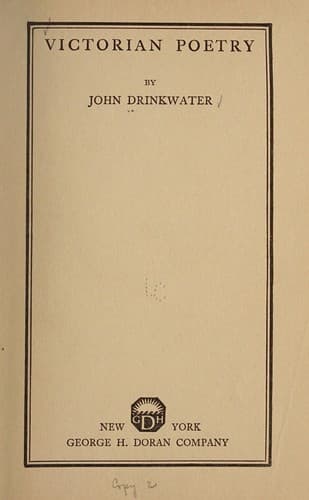
English poetry -- 19th century -- History and criticism; Great Britain -- History -- Victoria, 1837-1901
Macaulay was not by habit or any deep artistic intention a poet at
all, and the _Lays_ are little more than spirited footnotes to his
history, a point aptly made by Professor Hugh Walker in his scholarly
study of Victorian literature, but as such they are the work of a very
vivid talent and have a secure if humble place among the memorable
poetry of their age. There is no work of the time exactly comparable to
Macaulay’s unless it be that of William Edmondstoune Aytoun, but the
_Lays of the Scottish Cavaliers_, far from being without merit though
they are, have no special characteristics that call for mention here.
All the greater poets of the age tried their hand at some time or
another at objective narrative verse, but Morris alone among them made
narrative a chief concern of his art. _The Life and Death of Jason_,
_The Earthly Paradise_ and _Sigurd the Volsung_,[17] together make up
a body of narrative poetry by virtue of which it would be difficult to
call Morris in this kind the inferior of any one but Chaucer. Morris
had not Chaucer’s sense of character, nor his humour, nor, perhaps,
the variety of his invention, but in pure narrative gift, the art of
keeping the reader’s attention fixed upon the progress of a long story,
it is doubtful whether he is to be placed even below Chaucer himself.
It is, however, when we call to mind that quality in Chaucer which,
I have suggested, gives his art something of the comprehensiveness
that is supremely achieved in _King Lear_, that we feel Morris, great
poet though he was, to have been definitely the less considerable man
of the two. Morris loved the world of his invention, and loved it
passionately, but his narrative poetry is not quite authoritatively
marked by his own spiritual agonies and exultations. In speaking of
so noble a poet, and one so rich in pleasure-giving, one would say
nothing that should savour at any distance of disparagement. Nor is
Morris to be belittled because Chaucer was his master, not only by
example, but by achievement. At the same time, in Morris’s narrative
poetry, however splendidly it may compel every other honour, there is
to those who love it a perplexing something which leaves it short of
the very highest. In a strange and impalpable way it seems as though
he had withheld some last heart-beat from its creation. His claim,
frequently made, that the writing of poetry was easy is not without
some symbolic significance. It may have been that Morris was too happy
a man to be quite among the very greatest poets. His verse stories
leave us with a feeling that he is not utterly exhausted after the
act of creation, that the figures of his invention, tender and virile
though they are, remain outside the inner secrecies of his own emotion.
There is, in fact, a larger preponderance of exclusively objective
intention in his work than in Chaucer’s, and by so much he means the
less in the final poetic reckoning. This is not to forget that, by
Public-domain text, read in full here on John Shaqi.
Reviews
Reviews
No reviews yet
Be the first to share your thoughts on this work.
Elsewhere in the archive
Join the Discussion
Join the discussion
Sign in to leave a comment or review.
Sign InorCreate an account