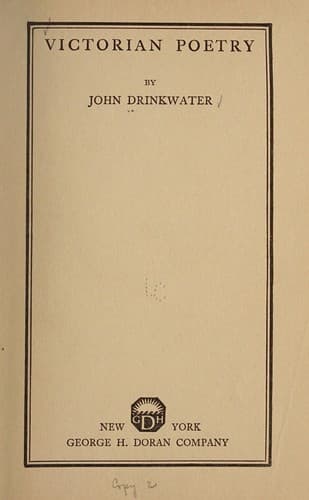
English poetry -- 19th century -- History and criticism; Great Britain -- History -- Victoria, 1837-1901
comparison with any narrative poet other than Chaucer, Morris’s work
is flooded with subjective passion, far beyond that of Macaulay or of
Scott himself. In the earlier part of this study I have suggested that
Morris really lived in the world of his stories more actually than
in the nineteenth century, and that is, I think, the truth. But his
capacity for imaginative life at all, immense though it was, had always
just a strain of decorative facility that marked it a little apart from
the constant imaginative pressure that we find in Chaucer. Morris told
us magnificent stories, very moving and quick with heroic life, and to
read them is to pass into a world of living and significant romance.
But, remembering our own mortality, he has not the touch of revelation
that was so easily Chaucer’s, not quite the same breath of apocalyptic
love.
The narrative work of the other great Victorian poets hardly calls for
special consideration, being incidental to and of a part with their
normal practice, not the result, as with Morris, of a specific artistic
plan. But at this point a word may be said of the many dramas that were
written during the age, in which we should expect from the nature of
this form something of that unification which has been referred to in
what has been said about Chaucer and _King Lear_. The Victorian
poets as playwrights, and they nearly all tried their hands at the
craft, suffered from the radical disability of having no living theatre
in which to learn their craft and in which to see their invention come
to full embodiment. This is not the place to discuss the reasons why
it came about, but the fact remains that when Tennyson began to write
the English theatre had long since driven out the spirit of poetry,
and continued to enforce the exile during the whole of his long life.
The waste of energy incurred by Tennyson and Browning and Morris and
Swinburne and Arnold, not to name a number of less celebrated men,
in the writing of plays (of the succession of poets preceding them
the same thing could be said) is one of the tragic futilities both of
English literature and of the English theatre. It was a time when the
actor had achieved complete ascendency in the theatre and when what
he wanted was, not creative poets whose works he could perform, but
hack playwrights who could serve the purpose of his own histrionic
virtuosity. No more of this need be said here, but the list of
Victorian plays written by men of great poetic gifts is a pathetic
witness of the indomitable aspirations of the English genius towards
drama and of the shameless indifference through long periods of the
theatre towards those aspirations. What these men might have done in
a fortunate theatre cannot be said, but in view of the very imperfect
evidence available it would be quite unsafe to say of any one of them
that he had not the gifts that would have served a great theatre
greatly. In the event, their dramas were, for the most part, little
Public-domain text, read in full here on John Shaqi.
Reviews
Reviews
No reviews yet
Be the first to share your thoughts on this work.
Elsewhere in the archive
Join the Discussion
Join the discussion
Sign in to leave a comment or review.
Sign InorCreate an account