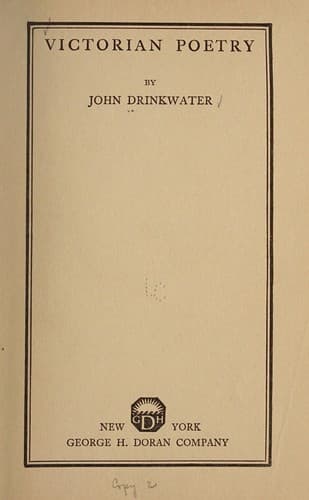
English poetry -- 19th century -- History and criticism; Great Britain -- History -- Victoria, 1837-1901
The common opinion, even the common critical opinion of some authority,
that has been expressed in recent years about the _Idylls of
the King_ is a striking instance of this lack of balance and
generosity. In the first place, we have been told over and over again
that Tennyson emasculated Malory, that the new poet’s Arthur was a
Victorian gentleman reflecting the stiff glories and virtues of the
Prince Consort’s train, not the fiery warrior with a vigorous paganism
shining through his Christian professions that lives in the pages of
the old chronicler, and that the ladies of the _Idylls_ have
become stultified by the proprieties of a later court than Guinevere’s.
Setting aside the sneer implied by the use of the figure of Victorian
gentility, a sneer that really bears far less examination than its
agents may suppose, the charge is a true one, but it is difficult to
see why it should be held to be very damaging to Tennyson. It may be
readily allowed that his world, his sense of character, and his ideals
of conduct, were not precisely, or even approximately, those of Malory,
but I am not aware that he ever claimed that they were, or that in
using the figures of Arthurian legend he was not as entirely justified
in making his own interpretation as Malory had been in his own time
in making his. Nothing is sillier in criticism than to come to an
artist’s presentation of a legendary, a romantic, or even an historical
figure with an already fixed idea of what that presentation should be.
The evidence about these things in almost every case leaves the way
open to a dozen conclusions, any one of which may carry conviction so
long as the artist is capable of creative singleness of heart. We are
really impertinent if we demand that Tennyson should make of Arthur
and Enid and Geraint and Lancelot and Guinevere and Merlin and Vivien
something that squares with our anterior impressions gathered from
Malory. All we are justified in demanding is that Tennyson shall give
them life which would convince us of its reality had we never heard of
them before. If it be argued that in that case Tennyson might just as
well have invented a _personnel_ of his own, the answer is that
the poet since the beginning has always, and justly, felt himself to
be at liberty to draw upon the common stock of legend and history so
that he may profit by the appeal made by a familiar setting and invest
his creation with the elemental vitality that comes from association.
When the Greek audiences went to see a new tragedy by one of their
masters they knew beforehand that they would be shown a _dramatis
personæ_ with whose existence they were already familiar, and so the
poet started off with the advantage of having an audience that took
it for granted that the people of his play were really alive. But the
gain carried with it for him no obligations, or, at least, none that he
would not as a matter of course instinctively fulfil. That is to say,
Public-domain text, read in full here on John Shaqi.
Reviews
Reviews
No reviews yet
Be the first to share your thoughts on this work.
Elsewhere in the archive
Join the Discussion
Join the discussion
Sign in to leave a comment or review.
Sign InorCreate an account