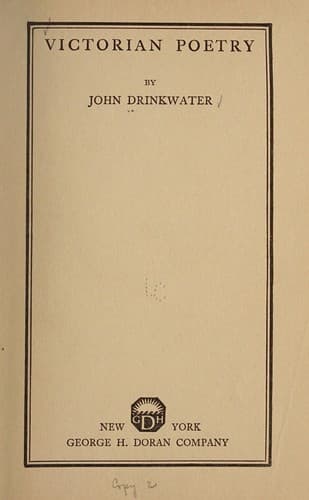
English poetry -- 19th century -- History and criticism; Great Britain -- History -- Victoria, 1837-1901
Nothing is vainer than for criticism of poetry to suppose that it
can give anything of the pleasure to be found in poetry itself. In
making these notes about Victorian poetry, and in reading over again
the work of the masters who wrote it, I am acutely aware how dismally
inadequate any commentary upon such work must be. I am aware, also,
that one could confront every generalisation that one makes with some
modifying example; I have, for instance, since saying what I did
about the love poetry of by-gone ages, been haunted by Bishop King’s
exquisitely personal and touching _Exequy_ on his “dead saint.”
But these exercises have their times, and they are at least an occasion
for refreshing memories that are apt to become a little dulled even
for the most loyal and industrious of us. Further, abstract theorising
about art at least does the art no harm and may sometimes serve it.
No one is likely to read the _Morte d’Arthur_ or the _Garden
of Proserpine_ or the _Scholar Gipsy_ or _Pippa Passes_
with any more poetic delight for anything that he may find in this
essay, but here and there a friendly mind may get a little pleasure of
a real though less essential kind in considering for a moment, apart
from the fundamental things of poetry that persist from one generation
to another, what were the characteristics that distinguished an age,
of which these are representative creations, from the other ages with
which it has now taken an equal and immortal place.
INDEX
A
Abercrombie, Lascelles, 19
Arnold, Matthew, 20, 21, 31, 32, 55, 66, 102, 109–114, 121–125,
134, 149, 151, 173, 210, 220, 228
Aytoun, William Edmondstoune, 169
B
Beardsley, Aubrey, 143
Blake, William, 23, 24, 31, 211
Bottomley, Gordon, 20
Bridges, Robert, 107
Brontë, Emily, 219
Brooke, Stopford, 202
Brown, T. E., 143, 146
Browne, Thomas, 114
Browning, Robert, 22, 32, 55, 92–103, 109, 114–117, 119, 142–147,
153, 156, 173, 210, 212, 217, 220, 226, 228
Browning, Elizabeth Barrett, 22, 214, 220, 226, 227
Bunyan, John, 165
Burbage, Richard, 64
Burns, Robert, 49
Butler, Dr. (of Trinity), 202
Byron, Lord, 22, 26, 49, 54, 64, 77, 94, 96, 125, 200, 225
C
Chapman, George, 51
Chaucer, Geoffrey, 35–37, 41, 56–59, 72, 74, 126, 131, 167, 170–173
Clough, Arthur Hugh, 104, 107
Coleridge, Samuel Taylor, 52
Collins, William, 23, 24, 44
Cory, William, 105
Crashaw, Richard, 17, 41, 219
D
Dante, Alighieri, 223
Davies, W. H., 19
Disraeli, Lord Beaconsfield, 202
Dixon, Richard Watson, 106, 107
Domett, Alfred, 143, 145
Donne, John, 17, 31, 38, 78, 114, 212, 225
Dowson, Ernest, 143
Drayton, Michael, 215
Dryden, John, 17, 200
E
Eliot, George, 202
F
FitzGerald, Edward, 202, 207, 215–219, 228
G
Public-domain text, read in full here on John Shaqi.
Reviews
Reviews
No reviews yet
Be the first to share your thoughts on this work.
Elsewhere in the archive
Join the Discussion
Join the discussion
Sign in to leave a comment or review.
Sign InorCreate an account