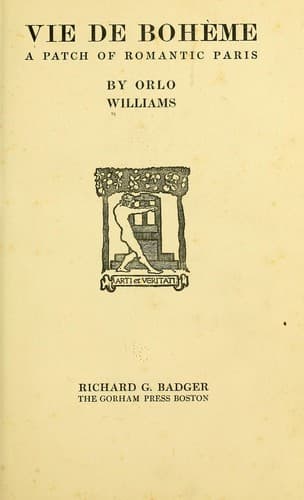
Vie de Bohème: A Patch of Romantic ParisWilliams, Orlo
History
Vie de Bohème: A Patch of Romantic Paris
Williams, Orlo
Paris (France) -- Intellectual life; Paris (France) -- Social life and customs
tried to be paid. Rodolphe edited a small fashion paper, _L'Écharpe
d'Iris_; Marcel painted ruined manors for a Jew dealer and portraits of
the lowliest possessor of a few spare francs; Colline gave lessons in
the same range of subjects as Pico di Mirandola professed to discuss;
and Schaunard, besides exhibiting a special ability as a borrower, put
music to bad poetry for hard-hearted music-publishers.
In comparing this Bohemia with that of Gautier and Gérard de Nerval, it
is easy to see the justification of Lepelletier's epithet "carottière."
The graceful adjuncts and by no means contemptible achievements of a
former day had vanished as completely as its enthusiasms. The presence
of Roger de Beauvoir and Nestor Roqueplan in the Rue de la Tour
d'Auvergne is as difficult to imagine as the composition of
"Mademoiselle de Maupin." Yet Rodolphe and his friends were at least as
well off in one respect, that is, in their affairs of the heart, if,
indeed, they had not some advantage. The divinities of the Impasse du
Doyenné, Cydalise excepted, seem to have had their home in the _corps de
ballet_, a body not notable for the tenderness or constancy of their
attachments. Murger, who, like his Rodolphe, was an amorous
sentimentalist, gave some poetic value, if not as much as he intended,
to the figures of Mimi and Musette, the idols of Rodolphe and Marcel,
who play such a prominent part in the "Scènes de la Vie de Bohème," that
it would be an affectation not to speak of them, although an Englishman
must always do so with some reserve. In spite of all that may be said
against them--indeed, _is_ said by their very creator--there is a charm
about Mimi and Musette which must always hold the reader of these
stories, a charm which includes Francine, who died holding the muff
bought for her by her lover, and the vulgar Phémie Teinturière, who
shared the lot of a no more refined Schaunard. Without sympathizing, at
least temporarily, with all the blend of mystery and frankness which a
Frenchman breathes into the word "amour," it is useless to read French
literature. To him love is the highest emotional value--emotion being in
its turn the highest value in life--so that a union, whether it be
celebrated in the Madeleine or in the _mairie_ of the notorious
thirteenth _arrondissement_, is equally sacred and equally interesting.
We in England look at love differently and, as we naturally think,
better, but we are not hindered, nevertheless, from abandoning our view
occasionally. We do so implicitly when we shed tears over "La Dame aux
Camélias," over "Madame Butterfly," and over Mimi herself in Puccini's
"La Bohème." To be honest, then, we must accept Murger's view, if we
enjoy his book, as there is very little doubt that we do. We applaud
Musette when she surreptitiously waters the flowers whose duration is to
measure that of her love for Marcel; we forgive her fickleness because
she follows her fancy without calculation, even though on leaving the
Public-domain text, read in full here on John Shaqi.
Reviews
Reviews
No reviews yet
Be the first to share your thoughts on this work.
Elsewhere in the archive
Join the Discussion
Join the discussion
Sign in to leave a comment or review.
Sign InorCreate an account