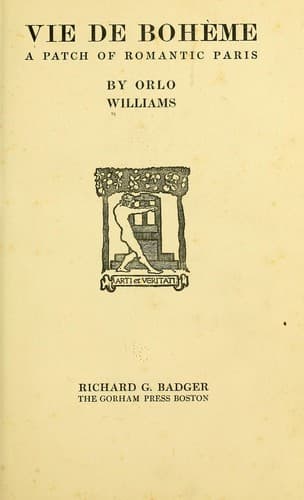
Vie de Bohème: A Patch of Romantic ParisWilliams, Orlo
History
Vie de Bohème: A Patch of Romantic Paris
Williams, Orlo
Paris (France) -- Intellectual life; Paris (France) -- Social life and customs
Privat d'Anglemont, who eventually died of consumption, did little more
than carry on the traditions of the "noctambules," less mischievously
than their founder, Rétif de la Bretonne, less modestly and artistically
than Gérard de Nerval, but so much more seriously than either of his
predecessors that he left little scope for a new departure to his own
successor, Alfred Delvau. He was not, in the truest sense, a Bohemian,
though he led an existence ever bordering on the confines of Bohemia.
The same may be said, in a more transitory sense, of Flaubert, the great
renovator and refiner of Romanticism. Most of his life was spent in the
country, but there was a short period when he came to study law in
Paris, which, if it were not mentioned, might justify a challenge from
readers familiar with "L'Education Sentimentale" or Maxime du Camp's
"Souvenirs Littéraires." So far as the first of these books is
concerned, little time need here be spent in finding relevant points of
comparison. The last thing which Flaubert desired to portray in that
depressing picture was an existence in any sense artistic. His hero is a
provincial youth who, during his student days in Paris, drifts aimlessly
and indolently through a variety of second-rate experiences in company
with second-rate friends. Flaubert's own experiences are, no doubt,
frequently worked into the material, but "L'Education Sentimentale" is
nothing so cheap as autobiography served in a thin sauce of fiction. It
is a novel in which the author has with the highest exercise of
penetrative imagination treated what Mr. Henry James would call the
"germ"--the dreary wastefulness, that is, of such a life in case of such
a young man as Frédéric Moreau, who with Madame Bovary is Flaubert's
contribution to the pathology of _le mal romantique_. Flaubert himself,
with all his excitability and extravagance, was of a much stronger
stamp; the strength of his artistic conviction saved him from all such
flabbiness. He came to Paris to study law, but, having failed to pass
his examination, returned to his home in 1843. If he had stayed he might
easily have become one of the leading figures, certainly a powerful
influence, in that Bohemia which Murger knew. Maxime du Camp, who made
his acquaintance early in 1843, shows him as a young man living always
at a high pitch with the flamboyant vitality that would have done no
dishonour to the Impasse du Doyenné, so far was he from being the victim
of Frédéric's weak-kneed desolation. He passed his days in an
alternation of prodigality and poverty, spending fifty francs on his
dinner one day and feeding on a crust and a slab of chocolate the next.
He lived in a kind of intellectual tornado, both frantic and noisy. He
went into ecstasies over mediocre works in which he perceived beauties
hidden from the rest of the world, but which he loved to point out
stridently to his friends, intoning the prose, roaring the verse at the
Public-domain text, read in full here on John Shaqi.
Reviews
Reviews
No reviews yet
Be the first to share your thoughts on this work.
Elsewhere in the archive
Join the Discussion
Join the discussion
Sign in to leave a comment or review.
Sign InorCreate an account