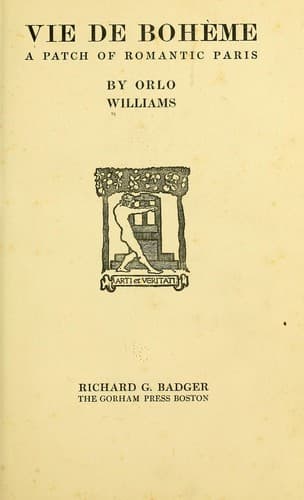
Vie de Bohème: A Patch of Romantic ParisWilliams, Orlo
History
Vie de Bohème: A Patch of Romantic Paris
Williams, Orlo
Paris (France) -- Intellectual life; Paris (France) -- Social life and customs
St.-Louis, where his comrade was the painter Boissard, a good artist
who, as Gautier said, exhausted himself in enthusiasms, and in whose
wonderful Louis XIV salon the society of _hachischiens_ met. Had
Baudelaire been a true Bohemian at heart he might have instituted a
second _Bohème galante_, but he was wanting in that simplicity and
goodfellowship which are signal qualities in the Bohemian character. He
wished to make his life, like his art, a study in exquisite intensity,
so that in the days of his splendour his mode of living was rather that
of a "dandy" than anything else. He dressed with immense care, but in a
bygone fashion; he pursued every kind of sensation, frequented every
kind of society, and became the leader of a set who carefully cultivated
eccentricity for its own sake, an eccentricity too _posé_ to serve as a
type of Bohemian manners. To make himself a subject of astonishment was
his chief amusement, to which end his devices--such as entering a
restaurant with a friend and feigning to begin a story with the loud
exordium: "After I had murdered my poor father----"--were innumerable.
So much may be said with a certain pity or amusement, but it must also
be admitted that a certain refinement, both social and intellectual,
kept him from associating himself entirely with the not
over-discriminating Bohemia of his generation. It is all the more fair
to say this because after 1844, when his stepfather got a guardian
appointed to take charge of his remaining capital and he was reduced to
eking out a reduced income by journalism, with all its attendant
disappointments and hardships, he chose with some discrimination the
extent to which he would throw in his lot with the Bohemian life for
which he had by that time every qualification. He became a friend of
Murger and many other complete Bohemians, and there is a story of his
asking the original of Schaunard to dine and giving him a piece of Brie
cheese and two bottles of claret, asking him to imagine that he was
enjoying the dessert after a good dinner. Yet his real intimates were a
band of young men, Théodore de Banville, Charles Monselet, Villiers de
l'Isle Adam, and Leconte de l'Isle, who chose to maintain a certain
amount of order in the midst of eccentricity and found boisterous
joviality less to their taste than the more delicate affectations of
wit. Here again I hold no brief for the complete Bohemians. They had
their compensating virtues, but it is hardly doubtful that Baudelaire
and his friends were the better educated and the more truly artistic set
of the two. This, perhaps, was the greatest tragedy of Bohemia's
decline, that its spiritual distinction faded with its material
well-being. At any rate, for a combination of reasons, laudable and the
reverse, Baudelaire's set was not Bohemia, and if, as I leave them, I
may insist particularly on one of the less laudable reasons, it is that
pose, which is another form of convention, must by the very conception
Public-domain text, read in full here on John Shaqi.
Reviews
Reviews
No reviews yet
Be the first to share your thoughts on this work.
Elsewhere in the archive
Join the Discussion
Join the discussion
Sign in to leave a comment or review.
Sign InorCreate an account